Another
Reverend Bruce Manning Metzger
Does Your Dog Bite Moment
Does Your Dog Bite Moment
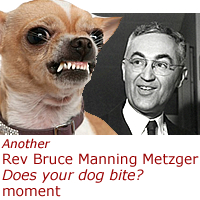 Guy
walks into a bar and sits down next to Bruce
Manning Metzger and a dog.
Guy
walks into a bar and sits down next to Bruce
Manning Metzger and a dog.
"Does your dog bite?" asks the guy.
"No," says Reverend Metzger
So the guy bends over to pet the dog—which bites a big chunk out
of his hand.
"You said your dog didn't bite!" says the guy.
"That's not my dog," says
Reverend Metzger.

 admitted
the Gospel of Matthew was written anonymously,
and here he's admitting the church legend that
the disciple Matthew wrote the gospel is impossible—because
the Gospel of Matthew gets
much of its material from the the Gospel
of Mark, and the traditional Christian
legend says Matthew did know
Jesus, but Mark did not. A
guy (Matthew) who did know Jesus wouldn't
get his Jesus stories from a guy who didn't
(Mark). So, whoever wrote the Gospel of Matthew
cannot have been the disciple Matthew. Is your
head spinning?
admitted
the Gospel of Matthew was written anonymously,
and here he's admitting the church legend that
the disciple Matthew wrote the gospel is impossible—because
the Gospel of Matthew gets
much of its material from the the Gospel
of Mark, and the traditional Christian
legend says Matthew did know
Jesus, but Mark did not. A
guy (Matthew) who did know Jesus wouldn't
get his Jesus stories from a guy who didn't
(Mark). So, whoever wrote the Gospel of Matthew
cannot have been the disciple Matthew. Is your
head spinning?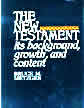 This
is all standard academic stuff. Reverend Metzger
can't have his bible book taken seriously if
he leaves it out. Anyway, in this passage I'm
about to quote from, Reverend Metzger has just
admitted the Gospel of Matthew was written anonymously.
And, he says, the church's legend about the
disciple Matthew being the author is impossible.
This
is all standard academic stuff. Reverend Metzger
can't have his bible book taken seriously if
he leaves it out. Anyway, in this passage I'm
about to quote from, Reverend Metzger has just
admitted the Gospel of Matthew was written anonymously.
And, he says, the church's legend about the
disciple Matthew being the author is impossible.