|  |
||||||||||||||||||||||||||||||||
 |
|||||||||||||||||||||||||||||||||













| Getting Started | Facts > Triumph > Syncretic Judaism |
| Hellenism | Syncretic Judaism | Jesus legend | Jesus Scholarship | |
 |
Apostolic Legend | Apostolic Scholarship | Over Paganism | Over other Christianities |
 |
No one alive when Jesus lived ever mentioned Him |  |
|
...the religion of
Israel did not invent even one myth. The evidence of the similarities
between Canaanite and Israelite societies has led to a major change
in the general understanding of the relationship between these two societies.
Rather than viewing them as two separate cultures, some scholars
define Israelite culture as a subset of Canaanite culture.
|
Pagan origins of the Old Testament
|
|
An example Moses got the goods straight from God, right? Sure. Back then lots of tribes got their holy laws straight from God. Here's the ancient historian Diodorus Siculus (1st century BC) describing how it worked. >> Diodorus says: The Jews got their holy laws from their God, just like pretty much everyone else got their laws from their Gods.That's how the ancients saw it. Of course nowadays we see the Jewish version of this ancient Pagan custom as special. But the truth is we care about Judaism only because of it's special relationship to Christianity. William Ewer's "How odd of God to choose the Jews" isn't right. God didn't choose the Jews, western culture chose Christianity, Judaism was just the bow on the package. We keep it around for sentimental reasons. How do we know this? Here's one way. In ancient times there were Samaritan
Jews, a big time version of the Judaism you know about. They
even had their own Christ, a first century miracle worker named Simon
Magnus. (You knew there was a Samaritan Jewish Christ,
right?) You heard about Samaritan Judaism lately? No one cares. We care
about our Judaism—because we care about our Christianity.
"It's not God but youse what choose the Jews." |
After the establishment of settled life
in Egypt in early times. . . the first, they say, to
persuade the multitudes to use written laws was Mneves,
a man not only great of soul but also in his life the most public spirited
of all lawgivers whose names are recorded. According to the tradition
he claimed that Hermes
had given the laws to him, with the assurance that
they would be the cause of great blessings, just as among the Greeks,
they say, Minos did in Crete and Lycurgus
among the Lacedaemonians, the former saying that he received his laws
from Zeus
and the latter his from Apollo.
Also among several other peoples
tradition says that this kind of a device was used
and was the cause of much good to such as believed it. Thus it is recorded
that among the Arians Zathraustes
claimed that the Good Spirit
[Ahura Mazda] gave him his laws,
among the people known as the Getae who represent themselves
to be immortal Zalmoxis asserted the same of their
common goddess Hestia,
and among the Jews Moyses
referred his laws to the god who is invoked as Iao. [translator's
note: This pronunciation seems to reflect a Hebrew form Yahu ; cp. Psalms
68. 4 "His name is Jah."] |

|
Canaanite-ism |
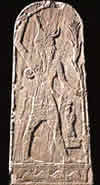
| You wanted to piss off an OT prophet? Just sacrifice to Baal. Drove 'em wild. >> |
You, Judah,
have as many gods as you have towns;
you have set up as many altars to burn sacrifices
to Baal as there are streets in Jerusalem. |
|
In fact, early Judaism, way way back, developed as a sect of Canaanite religion. |
|
|
The evidence of the similarities between
Canaanite and Israelite societies has led to a major change in the general
understanding of the relationship between these two societies. Rather
than viewing them as two separate cultures, some scholars
define Israelite culture as a subset of Canaanite culture.
|
 Judaism,
our Judaism, a sect of Canaanit-ism?!
This is just Greg bloviating, right? Nope. Here's a synopsis
of the current state of the scholarship, from Mark Smith,
a hot shot in the field and Skirball Professor of Bible
and Ancient Near Eastern Studies at New York University (although
I doubt it makes getting dinner reservations any easier) >>
Judaism,
our Judaism, a sect of Canaanit-ism?!
This is just Greg bloviating, right? Nope. Here's a synopsis
of the current state of the scholarship, from Mark Smith,
a hot shot in the field and Skirball Professor of Bible
and Ancient Near Eastern Studies at New York University (although
I doubt it makes getting dinner reservations any easier) >>
|
And in case you think Dr. Smith is bloviating, here's a smattering of the facts he cites. >>
What Dr. Smith points out is that a number of technical religious words are the same in Ugaritic as they are in Biblical Hebrew. He gives a list, and he gives citations so you can go look them up if that will make you happy.. His point is: "This incidence of highly specialized sacrificial terms suggests a common West Semitic heritage."
[KAI and KTU are the standard li-bary books for Ugaritic texts. |
The Canaanite (or, West Semitic)
background of Israel's culture extended to the realm of religion.
This is evident from the terminology
for cultic sacrifices and personnel. BH [Biblical Hebrew] sacrificial
language with corresponding terms in Ugaritic and/or Phoenician includes Other terms have been viewed as semantic equivalents
in Hebrew and Ugaritic. It is assumed, for example, that BH
|
||||||||
|
Judean Paganism
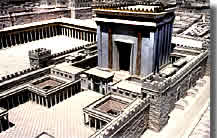
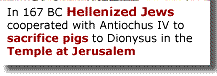
Think of it this way: In 167 BC Judea's foreign ruler, a guy named Antiochus IV, forced the Jews to give up their temple sacrifice and switch to his Pagan temple sacrifice (to Zeus, probably; some scholars think Dionysus). Of course some of the Jews were highly upset, but that's not the point. The point is this: all that changed was the animal killed and the name of the God. The fact that an animal was killed—at an altar, in a God's temple, with incense, that part was burned for the god and the rest was eaten—and that everyone, Pagan and Jew, knew exactly how that worked and what it meant, that didn't change. Judaism was continuous with Paganism. Wow. Bet you didn't pick that up in church. |


|
Is this just Greg talking? Nope. The ancient Jews understood that their sacrifices worked just like pagan sacrifices. How do we know this? Simple: they said so. Here's Philo (a famous first century AD Jew from Alexandria in Egypt) saying just that.
Pretty easy so far, huh?
So anyway, after the riots the Jews and the Greeks of Alexandria each sent people to Rome, to 'splain their side of the mess, and to get Caligula to maybe take their side before any impereal head-banging action got going. |
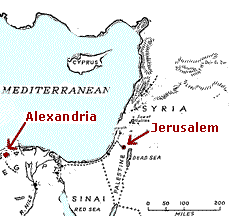 First,
a little background. Alexandria was a big city in Egypt.
LIke everything else in the first century, it was run by the Romans.
Lots of Jews lived in Alexandria. Lots of Greeks
lived there too.
First,
a little background. Alexandria was a big city in Egypt.
LIke everything else in the first century, it was run by the Romans.
Lots of Jews lived in Alexandria. Lots of Greeks
lived there too. The
two groups, the Jews and the Greeks, didn't get along—in fact
in 38 AD they rioted. News of the
riots got to the Roman emperor, a fellow named Gaius (you know him by
his nickname, Caligula). Now, Caligula was a guy who
never stayed mad long—generally he had the people he was mad at
(people like, say, rioters) killed, after which he felt all better.
Being Emperor was very stressful and he felt he deserved to relax sometime.
I'm sure that deep down Caligula was a nice fellow.
The
two groups, the Jews and the Greeks, didn't get along—in fact
in 38 AD they rioted. News of the
riots got to the Roman emperor, a fellow named Gaius (you know him by
his nickname, Caligula). Now, Caligula was a guy who
never stayed mad long—generally he had the people he was mad at
(people like, say, rioters) killed, after which he felt all better.
Being Emperor was very stressful and he felt he deserved to relax sometime.
I'm sure that deep down Caligula was a nice fellow.|
|
Isidorus [the Greek envoy], that bitter sycophant, realizing that Gaius enjoyed being offered titles beyond human nature, said: 'You are going to hate these Jews here, my lord, and their fellow- countrymen more than ever when you hear about their ill-will and impiety towards you. For when all humanity was offering sacrifices of gratitude for your recovery, these were the only ones who could not bear to perform sacrifice. By "these" I mean to include all the other Jews as well.' |
||||
|
The Greek envoy, Isidorus, right off tried to pin the mess on the Jews. How could Gaius (Caligula) trust the Jews, Isidorus said, when the Jews refused to sacrifice to him? |
|||||
Not so fast, shouted the Jews, "We are being slandered; we did sacrifice." And they went on to describe the Jewish temple sacrifice, done in the standard Jewish way, which was also the standard Pagan way, and everybody knew it, and no one bothered to say they were different—'cause they weren't different. They were the same. Philo said so. Isidorus agreed. Gaius agreed. They were the same. Got that?
|
At that we all shouted out together, 'Lord
Gaius, we are being slandered; we
did sacrifice -we sacrificed whole hecatombs. And we did not
just sprinkle blood on the altars (as some people do)
and then take the meat home for feasting and celebrations, but
put the whole offering into the sacred flame to be burned up. We
have already done this not just once but three times: the first time
was on your accession as emperor; the second was on your recovery from
that dreadful illness that the whole world suffered with you; the third
was in expectation of your triumph in Germany.' 'It may be true,' Gaius
replied, 'that you did sacrifice but you sacrificed
to somebody else, even if it was on my behalf. So where's
the merit in that? You did not sacrifice to me.' Immediately
we heard that, following on his previous remark, we were seized by a
violent trembling, such that it was beyond all concealment. |
 Philo,
who was in the Jewish group, wrote down what happened.
Today, you can still read what he wrote. .
Philo,
who was in the Jewish group, wrote down what happened.
Today, you can still read what he wrote. .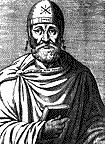
|
Jewish sacrifice was Pagan sacrifice. Jewish worship was Pagan worship directed at the Jewish tribal God. Judaism was Paganism. Judaism was the version of Paganism that developed in Judea. Cool, huh? |
|
Here's an example of some Pagan hocus pocus—just the sort of purity rules and ritual taboos that defined Paganism >>
|
[The Pythagoreans
say] A state of purity is
brought about by purifications, washings
and lust rations, by a man's purifying himself from all deaths
and births, or any kind of pollution,
and by abstaining from all
animals that have died, from mullets,
from gurnards, from eggs,
from such animals
as lay eggs, from beans,
and from other things that are prohibited by those who have charge of
the mysteries in the temples. |
|
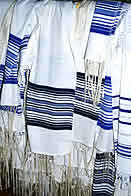
Sound familiar? It should. Modern Judaism keeps alive a lot of the ideas and rituals of pre-Christian ancient religions. Modern Jewish practices like food and other ritual taboos, head covering, the tribal "monotheism” of a God interested in a single people (always “us,” whoever us was), are vestiges of practices and beliefs shared by pre-Christian religions around the Mediterranean. Wow. |
|
Is that just Greg's opinion? Naah. Other than their tribal monotheism, the ancient pagans saw the Jews as pretty much like everybody else. Here's how the Roman emperor Julian put it >> |
The Jews behave like the Gentiles [Pagans] except that they acknowledge only one god. This is something distinctive to them, but alien to us. As for everything else, though, we share common ground—temples, sanctuaries, altars, rituals of purification, certain injunctions where we do not diverge from one another at all, or only in insignificant ways. [Julian, emperor, Against the Galileans, fr 72 (306 B) ] |

|
The early Christians agreed >> |
Now the Jews became an individual nation, and make laws according to the custom of their country, and they maintain laws among themselves as the present day, and observe worship which may be very peculiar, but is at least traditional. In this respect they behave like the rest of mankind, because each nation follows its traditional customs…. Origen, Against Celsus, 5.25—which you can find in: Lee, A.D., Pagans & Christians in Late Antiquity (2000), pg. 46 |
|
Modern scholars like to trace the Pagan origins of Jewish ritual and myth, and because Pagan-Jewish syncretism isn't as threatening to most folks as Pagan-Christian syncretism, there's a wide scholarly agreement about Jewish borrowing.
Hot shot religion historian Mircea Eliade lists Jewish myths copied from earlier ancient cultures >>
|
"...Genesis preserved a whole mythology of the traditional type. It begins with the cosmogony and the creation of man, paints the "paradisal" existence of the ancestors, related the drama of the fall...,which justifies the flood, and concludes with..the loss of linguistic unity....As in the archaic and traditional cultures, this mythology... explains the origin of the world and... the actual human condition.... ...the religion of Israel did not invent even one myth. [Mircea Eliade, A History of Religious Ideas, volume 1 §55]
|
|||||||||


Professor Mark Smith's highly techncal (but readable) book traces Israeilite myths, rituals and theolgies back to earlier Caananite culture > >
|
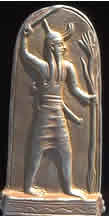
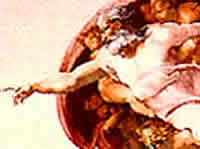
Biblical texts do attest to Yahweh and El as different gods sanctioned by early Israel. For example, Genesis 49:24-25 presents a series of El epithets separate from the mention of Yahweh in verse 18. This passage does not show the relative status of the two gods in early Israel, only that they could be named separately in the same poem. More helpful is the text of the Septuagint and one of the Dead Sea Scrolls (4QDeut) [both written BC] for Deuteronomy 32:8-9, which cast Yahweh in the role of one of the divine sons, understood as fathered by El, called Elyon if the first line:
| ||
  |
The traditional Hebrew text (MT) [the version
created AD] perhaps reflects a discomfort with this polytheistic theology
of Israel, for it shows in the fourth line not "sons of El"
but "sons of Israel." This passage, with the Septuagint and
Dead Sea Scroll reading, presents a cosmic order in which each
deity received its own nation. Israel was the nation which Yahweh received,
yet El was the head of the Pantheon and Yahweh only one of its members.
This reading points to an old phase of Israel's religion
when El held a pre-eminent position apart form the status of Yahweh.
Apparently, originally El
was Israel's chief god, as suggested by the personal name, Israel.
Then when the cult of Yahweh became more important in the land of early
Israel, the view reflected in Deuteronomy 32:8-9 served as a mode to
accommodate this religious development.
|
||
|
All very interesting, if you like that sort of thing. As I say, not my shtick. But if it's your's, I've listed a few books here to get you started. Go nuts. |
Good Books for this section
| Old Testament
Parallels 
 |
What you'll find:
There are lots of books like this to choose from. This is one of the clearest, most readable, and most comprehensive. Highly recommended.
|


|
|

| Ugarit
and the Old Testament (1983)
|
A nice little (110 page) general-audience introduction to Ugarit (modern Ras Shamara in Syrian), where clay tablets discovered in 1929 revealed a pre-Israelite Semitic civilization with gods and myths similar to, but earlier than, Old Testament gods and myths. If you can find it cheap, read this before you read Smith's Origins of Biblical Monotheism.
|


|
|
| The
Early History of God
|
Like Christianity, Judaism had Pagan origins. Sound kooky? It's mainstream scholarship, though you don't come across it often. This well written, easy to read book is by one of the preeminent experts in the field. Jewish ritual and mythology developed directly from Canaanite ritual and mythology. Yahweh was originally the son of the Canaanite God El and brother of the Canaanite God Baal. How do we know this? Ugarit. In 1927 they dug up a Canaanite clay tablet library buried at Ugarit, an ancient city along the northern coast of Syria. Hundreds of ancient texts. Same myths. Same rituals. Same Gods. Only centuries earlier than Judaism. Who knew?
|


|
|
| The Origins
of Biblical Monotheism
|
What you'll find:
For example: "[T]he priestly theological treatment of Israel's early religious history in Exodus 6:2-3 identifies the old god El Shadday with Yahweh:
This passage shows that Yahweh was unknown to the patriarchs. Rather, they are depicted as worshipers of El. In Israel El's characteristics and epithets became part of the repertoire of descriptions of Yahweh. Like El in the Ugaritic texts, Yahweh is described as an aged, patriarchal god ..., enthroned amidst the assembly of divine beings" [pg 141] It helps to know a bit about Ugarit before you start. Exhaustive, exhausting. Expensive—but worth every penny. HIghly re commented.
|

|
|
|
The Jews Among the Greeks and Romans,
A Diasporan Sourcebook
|
What you'll find:
|

|
|
|
Jews in the Mediterranean Diaspora
|
What you'll find:
|

|
|