|  |
||||||||||||||||||||||||||||||||
 |
|||||||||||||||||||||||||||||||||













| Getting Started | |||
| Scholars argue> | Yes | No | Jesus Theories |
| Facts > | Sourcebook Anthologies | Sourcebooks: ancient texts | |
| Background > | Ancient Civilization | Ancient Religion | Early Christianity |
 |
Special topics | Mystery Religions | Ancient Judaism |
| Amateur > | Pagan Origins | Hablo Greek-o | |
 |
Good books: the Top Four, and more |  |
You can get a good picture of the Pagan Origins question by reading just four books, in order: |

| Top
Four |
| Documents
For The Study Of The Gospels
|
What you'll find:
Think of this as POCM's blue
boxes in a book, without Greg's annoying commentary.
|
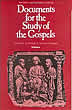

 Highly recommended.
|
Top
Four |
|

|
Gospel Fictions
|
What you'll find:
|

|
Top
Four |
|
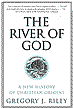
| The River
Of God
|
What you'll find:
If this book had been around in 1998, POCM would have been unnecessary.
|
| Top
Four, #5 |
|
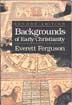
| Backgrounds
of Early Christianity
|
An outstanding
book to start with.
If you need a special-purpose book to understand Christianity's Pagan origins, then probably Christianity didn't have Pagan origins. It does; you don't. What you really need is a good book describing ancient Pagan culture and religion. This outstanding, easy to read book is the best I've read. From Greco-Roman religions (Mithras, Isis, Dionysus, Eleusis, the mystery religions, etc.) and philosophies (monotheism, the soul, life after death, etc.), on through an excellent section on Second Temple Judaism and another on early Christianity, you'll discover the facts and issues behind modern scholarship on Christian origins. I bought this book on a whim, figuring it would have a relevant section or two; I ended up reading the thing cover to cover, 600 delightfully clear and well written pages. But you don't have to read it cover to cover—just pick the section you're interested in.
|

| Top
Four |
|
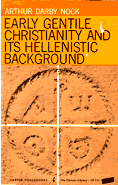
| Early Gentile
Christianity and Its Hellenistic Background
|
You'll find:
First published in 1928 and reissued and updated in 1964,
this is the canonical refutation of the late 19th and
early 20th century scholarly claims that Christianity borrowed
from Paganism. This essay is widely cited as an authority, "Dr.
Nock has refuted the German School. . .", and the arguments Nock
developed here are the same ones believers use today.
|
 |
Nock was a Harvard professor who read and understood the scholarship. He did not—could not, in that generation when scholars knew better—deny the deep similarities between Christianity and the Pagan mysteries. For example >> |
The Eucharist ...
is in line with contemporary mysteries, which purported to represent the
sufferings and triumph of a god, in which his worshipers sympathized and
shared....The Eucharist
is a mystery, as mysteries were then understood, and Christianity, the
heir of Judaism, has also an essential spiritual continuity with Hellenistic
religion.
|

|
|
Nock was also a committed Christian, a Doctor of Divinity who wasn't about to admit Christianity borrowed from Paganism, so for every similarity he comes up with a reason the similarity doesn't count. The 1964 Harper Torchbook edition is expanded
with Nock's later thoughts and arguments. It is out of print, but often available used through Amazon
|
| End
Top Four |
|
More than four Haven't had enough? Here are a few more great reads: |
| The Bible Geek Dr Robert Price |
The internet bypasses conventional thinking's choke hold on the ideas you get to know about. What you'll find:
|
||||||||||

|
|
|
| Greek Resurrection
Beliefs and the Success of Christianity
|
What you'll find:
Endsjo is a professional academic who for years heard and believed the regulation academic myth: The Christian theology of BODILY resurrection was new and unique. It could not have borrowed from Pagan ideas, because to Greco-Roman Paganism the body was corrupt. Eventually Endsjo decided to look at, you know, the ancient evidence. Oops. Turns out bodily resurrection was a widespread belief in pre-Christian Pagan and Jewish culture.
|

|
|
|
|
|
What you'll find:
Who you gonna trust? The ancients. Believing scholars shade the facts in favor of the myth. Non-believers exaggerate and make up facts and connections as a way to attack the church. So who are you going to trust? That's up to you. I trust the ancients—people alive back when Christianity began, and before. That's what this book is about. This is a sourcebook, a collection of primary documents—excerpts from ancient authors who wrote about Pagan religion and early Christianity. It's a great collection, with the original text of most of the standard ancient references to the pagan mystery religions. This is a powerful book. You'll discover firsthand, right from the pens of the ancients themselves, that Dionysus came to earth "incognito, disguised as a man"; that Pagan Gods died and were reborn with the meaning that "the God is saved, and we shall have salvation."; that pagans had initiation ceremonies seen as "a voluntary death", sacred meals shared with the God, ceremonial washing, Pagan miracles, a Godman who changed water into wine, and a Pagan version of the great flood. And much more. An important book that no serious student will be without. Highly recommended.
|
|
|
|
| Celsus
On the True Doctrine
|
What you'll find:
Celsus was a Pagan. In the second century AD he wrote a book pointing out flaws in Christianity. Of course Celsus points up the same contradictions and illogicalities in the Christian myth that people point up today. Ignore those. They aren't the point. The point is the things Celsus doesn't complain about—the things he takes for granted because they're part of his Pagan culture and his Pagan religion. Celsus doesn't attack Christians for believing in God, or in a godman, for the idea of a human soul, for Heaven or Hell or prayer or salvation or eternal life, etc., etc. Pay attention, while you read, to all the Pagan things in Christianity that Celsus doesn't attack—your ideas about Christianity will change forever. Wow. Highly recommended.
The original version of On the True Doctrine was
written in the second century AD by a Pagan guy named
Celsus. The Christains burned it; no copies sruvive. So where does this
book come from? In the third century one of the Church Fathers,
a fellow named Origen, wrote a long rebuttal (he called
it Against Celsus) that quoted Celsus idea by idea and often
word for word. Against Celsus does survive. This book uses it's long quotes
to reconstruct Celsus' book. Is it perfect? No. Is it pretty good? Yes.
|
|
|
|
| The Origins
of Biblical Monotheism
|
What you'll find:
For example: "[T]he priestly theological treatment of Israel's early religious history in Exodus 6:2-3 identifies the old god El Shadday with Yahweh:
This passage shows that Yahweh was unknown to the patriarchs. Rather, they are depicted as worshipers of El. In Israel El's characteristics and epithets became part of the repertoire of descriptions of Yahweh. Like El in the Ugaritic texts, Yahweh is described as an aged, patriarchal god ..., enthroned amidst the assembly of divine beings" [pg 141] It helps to know a bit about Ugarit before you start. Exhaustive, exhausting. Expensive—but worth every penny. HIghly re commented.
|

|
|
|
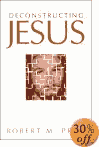
Deconstructing
Jesus
|
What you'll find:
Is this the final word on who Jesus was or wasn't? No, it's not. It is a useful look at the methods and conclusions of modern New Testament scholarship—by an academic who isn't impressed by either. Price is an academic who understands the orthodox scholarly theories, though he doesn't buy them. His theme is that nothing we know about Jesus is historical, everything is mythical. The book follows the regulation scholarship, starting with the "Jesus People," (an academic term for Jesus' first followers; the Jesus People weren't really Christians, since they didn't believe Jesus was God or that he had risen from the dead), on to the first groups who worshiped Jesus as God, the Christ-cults (another academic term), through Jewish Messianic expectations, non-orthodox early Christianities and even ancient novels, which reveal a cultural theme of escape from crucifixion. The point is not one-for-one parallels between Jesus and, say, Mithras or Osiris. The point is that the first Christians took the basic ideas of their culture and adapted them to their new faith. |
| |
| |
What
other people think about POCM |
|
Greg, I've been meaning to write to you for a several months to tell you how much I enjoy your web site. However my fear of seeing my email listed on your feedback page with all my spelling errors highlighted in red and an image of a dunce cap next to it has kept me at bay. Today though I'm confident my email spill chucker won't let me down.
|
||
 Last
year around this time I began researching old European Christmas customs
on the internet and stumbled onto a page which compared Mithras and
Jesus. I found the parallels intriguing and have been researching Christianity's
pagan origins ever since. Your web page has made my study so much easier.
I appreciate the methodical, well structured argument you laid out on
your web page, but it's your Good Books section that has been
the most helpful. In the last few months I've read Shorto's
Gospel Truth, most of Price's Deconstructing
Jesus, and sections of Koester's Introduction
to the New Testament Volume 2: History and Literature
of Early Christianity. Amazon just emailed me that Bauer's Orthodoxy
and Heresy in Earliest Christianity is on its way. It
looks like I'll have lots of good reading material this winter.
Last
year around this time I began researching old European Christmas customs
on the internet and stumbled onto a page which compared Mithras and
Jesus. I found the parallels intriguing and have been researching Christianity's
pagan origins ever since. Your web page has made my study so much easier.
I appreciate the methodical, well structured argument you laid out on
your web page, but it's your Good Books section that has been
the most helpful. In the last few months I've read Shorto's
Gospel Truth, most of Price's Deconstructing
Jesus, and sections of Koester's Introduction
to the New Testament Volume 2: History and Literature
of Early Christianity. Amazon just emailed me that Bauer's Orthodoxy
and Heresy in Earliest Christianity is on its way. It
looks like I'll have lots of good reading material this winter.