|  |
||||||||||||||||||||||||||||||||
 |
|||||||||||||||||||||||||||||||||













| Facts > Pagan Christs > Pythagoras | |||||
| Glycon | Simon | Apollonius of Tyana | Pythagoras | Orpheus | |
| Isis / Osiris | Dionysus | Zalmoxis | Kore | Samothrace | |
| Heroes | Attis | Adonis | Mithras | Other godmen |
 | Pythagoras—sixth century BC |  |
|
Yes, we are talking about the same guy your geometry teacher
tried to get you to care about, and by the time you're done here, you'll
actually may. Pythagoras is an iceberg—the bit
sticking up into geometry class doesn't show the tons of other stuff
hidden deep in the ancient texts. |

|
Pythagoras founded a religious tradition focused on God, morality, and the immortality of the human soul. He performed miracles. His disciples did miracles in his name. He went to Hades and came back. And his followers thought he was divine. Pythagoras was a real man. Now, you and I know he didn't really do miracles, or go to Hades and return, and he wasn't really God. But what we know isn't the point. The point is in ancient people thought he did miracles, they thought he went to Hades and came back, they thought he was divine. That's how the ancient world worked. Real men could become Gods—did become Gods. Sound familiar? Sure it does. Was Jesus new? Was Jesus unique? Nope. Pythagoras got there first. |
|
|

He lived in the sixth century BC..
|

...generations before Plato
|
|
Pythagoras was a big deal, away back then.Pythagoras' followers kept his phislosophy/ religion alive for generations and centuries. Plato, the ancients said, got his start by buying and reading a book describing the secret Pythagorean mysteries, which he then used to write his book Timaeus. Aristotle borrowed from him. Iamblicus and Diogenes Laertius and Porphyry wrote biographies that survive today. Even the Christian Chruch fathers quote him. We don't think about him much, I guess, because none of his own writings survive. |
Pythagoras taught that in heaven
there are twelve orders, the first and outermost being the fixed
sphere where, according to Aristotle, dwelt the highest
God, and the intelligible deities, and where Plato
located his Ideas. |
|
Pythagoras taught that no occurrence happened
by chance or luck, but rather in conformity to divine Providence, and
especially to good and pious men.[Iamblichus,
On
the Pythagorean Life, 28 (3d c AD),—which you can find
in: Gutherie, Kenneth. The Pythagorean Sourcebook and Library (1988),
pg. 93] |
|
|
| The Pythagorean
Sourcebook and Library
|
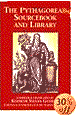
A sourcebook of ancient writings about Pythagoras and the Pythagoreans, everything from full biographies to one-line fragments. SEE Pythagoras perform miracles. All from the pens of the ancients themselves. Ooh yeah. (Guthrie collected and translated most of the stuff here, publishing a small run in 1920. Fideler dug up and added more Pythagorean stuff for the 1987 and 1988 editions—say that three times fast.)
|


|
|

| |