|  |
||||||||||||||||||||||||||||||||
 |
|||||||||||||||||||||||||||||||||













| Facts > Getting Started > Mysteries | |||
 |
Mysteries |
Sources |
 |
Godmen who bring salvation |  |
The keys of hell and the guarantee
of salvation were in the hands of the goddess, and the initiation
ceremony itself a kind of voluntary death and salvation through divine grace. |
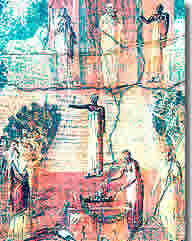

|
But so far it's looked like the ancients put these building blocks
together differently from Christianity [though not
from temple-sacrifice Judaism]. Civic
religion was largely about controlling the world by bargaining
with god-beings. Philosophy
was about ethics and morality (among other things), but it didn't involve
divine revelation. Neither focused on personal salvation. A third part of ancient religion, mystery religions, did focus on the afterlife. Mystery religions involved the worship of a walking, talking god-man (or god-gal) who gave His believers a better life after death—salvation. |
|
 We're
We're

Savior
Gods |
|
Plato describes the "mysteries," which he says "redeem us from the pains of hell" >> And without the mysteries, no one knows what will happen after we die. |
And they produce
a host of books written by Mousaios
[aka 'Moses'] and Orpheus, … according to which
they perform their ritual, and persuade not only individuals, but whole
cities, that expiations and atonements
for sin may be made by sacrifices and amusements which fill a
vacant hour, and are equally at the service of the living and
the dead; the latter sort they call mysteries,
and they redeem us from the pains
of hell, but if we neglect them no one knows what awaits
us. |
Plato,
The Republic, Book 2.7, (4th century BC)
|
Plutarch, in the 2d century AD says the same. Here we go... Salvation by Osiris Plutarch, the guy who wrote this next bit, was for thirty years a priest at the temple of Apollo in Delphi, Greece. He was a priest of Apollo, but he also worshiped Osiris. You've been paying attention, so him doubling up like this won't surprise you. Anyway, by his time Isis and Osiris had been in Greece for more than four hundred years, and it's a good bet Plutarch was initiated into their mysteries. He was a religious man; a believer. He traveled to Egypt and described the worship of Isis and Osiris there, and the theology behind it.Take a deep, cleansing breath. Your ideas about God and religion are about to change. |
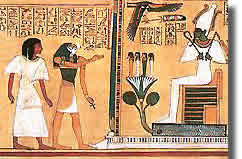
|
|
Look, I know you don't read most
of these blue boxes. This one you ought to |
|
Plutarch, who knew his way around a scroll with a reed pen, didn't have words to say how very very nice the worship of Isis was, so he settled for some hi-tone superlatives--"pure", "shining through the soul", like that. >> Lucky us, Plutarch didn't stop there. He went on to explain that the theology of Isis worship was mystic union with the immaterial, eternal "Reason." The Greek word was "Logos." -- the same word, and the same idea of an eternal divine being you'll find in our Gospel of John. "In the beginning was the word [logos], ... and the word [logos] was God." The Isis-priests' God wasn't a magical godgal (at least She wasn't only that), She was this eternal, immaterial, simple, shining, pure, spirit thing. The kind of transcendent God-thing I don't have words for, and I bet you don't either. According to Plutarch, who knew 'cause he was there, the worship of Isis and Osiris wasn't about magic fables, it was about mystic union of the striving human soul with eternal, transcendent God. >> In-fucking-credible. |
|
|
While we are alive
|
|
|
But while we are alive, we can't appreciate the goodness of God. The best we can do is get a dim view of God's gooduosity through—Plutarch being a rich Poindexter and all—through philosophy. >> |
|
|
After we die says Plutarch our souls leave our bodies and travel
to be with God, >> where.
...your soul will spend eternity contemplating the unutterable, indescribable niceness of God. >>
Sound familiar? I thought so. |
But when
these souls are set free and migrate into the realm of the invisible
and the unseen, the |
| Plutarch, Isis and Osiris, 382.D
- 383.A (first or second century AD), -- which you can find in: Babbitt,
Frank.
Plutarch Moralia, volume 5 (1936/ 1999), pg. 181- 5 .
|

 ....
this god Osiris .... is far removed from the earth,
uncontaminated and unpolluted and
pure from all matter that is subject to destruction and death
; but for the
....
this god Osiris .... is far removed from the earth,
uncontaminated and unpolluted and
pure from all matter that is subject to destruction and death
; but for the 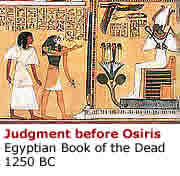
|
Our souls are divine, and strive for union with God. After we die we travel to heaven to spend eternity contemplating the unutterable, indescribable glory of God. That was ancient religion? Yup. That was ancient mystery religion. Who'd a thunk it? |
|
Many Secret |
|
 Mystery
Religions
Mystery
Religions|
The pure, simple, shining goodness of God was so very cool
and special that it could only be experienced once in life >> And being that special, it could not be revealed to outsiders. In the history of world religions, that little fact is a huge deal. |
|
| Plutarch, Isis and Osiris, 382.D - 383.A (first or second century AD), -- which you can find in: Babbitt, Frank. Plutarch Moralia, volume 5 (1936/ 1999), pg. 181- 5 |
The theology of the mysteries was a sacred secret. No one could write and circulate handbooks of mystery practice and theology. No one writing a book of history or biography could describe any details of mystery practice and theology. And they meant it. Ancient writers mention the mysteries a lot, but with one exception, they always pull back from disclosing sacred secrets. As we've seen they occasionally hint, or say outright, that the mysteries bring salvation, but beyond that the basic rituals and theologies of ancient mystery religions are gone. Lost. Which makes it impossible to line up Christian ritual and theology with ritual and theology of the other mysteries. Does Christianity look like a mystery? Yes. Did the early Christians say Christianity was a mystery? Yes. Can we prove the theologies and rituals line up? Nope, we can't. Very tantalizing. |
| |
|
Good Books for this section
|
|
What you'll find:
Who you gonna trust? The ancients. Believing scholars shade the facts in favor of the myth. Non-believers exaggerate and make up facts and connections as a way to attack the church. So who are you going to trust? That's up to you. I trust the ancients—people alive back when Christianity began, and before. That's what this book is about. This is a sourcebook, a collection of primary documents—excerpts from ancient authors who wrote about Pagan religion and early Christianity. It's a great collection, with the original text of most of the standard ancient references to the pagan mystery religions. This is a powerful book. You'll discover firsthand, right from the pens of the ancients themselves, that Dionysus came to earth "incognito, disguised as a man"; that Pagan Gods died and were reborn with the meaning that "the God is saved, and we shall have salvation."; that pagans had initiation ceremonies seen as "a voluntary death", sacred meals shared with the God, ceremonial washing, Pagan miracles, a Godman who changed water into wine, and a Pagan version of the great flood. And much more. An important book that no serious student will be without. Highly recommended.
|



|
|

| Mystery
Religions in the Ancient World
|
What you'll find:
A good introduction.
|


|
|
| The Mysteries
|
What you'll find:
Not a good introduction. Worth reading if you're an advanced student.
|
|
|
The
Mystery-Religions
|
What you'll find:
|
|
|
| Hellenistic
Mystery Religions
|
What you'll find:
|
|
|
The
Golden Ass
|
The ancients had novels (who knew?!), and this is one of them. And, believe it or not, it's a fun read, lighthearted, funny, and well written. The story moves. For the boys: it even has explicit sex. Amazing. Who knew?! The story is about Lucius' adventures after he gets turned into a donkey. The first ten chapters are just fun, not related to the Pagan origins. Chapter eleven is about Lucius in Egypt, and his study and initiation into the mysteries of Isis and Osiris (he's a man again by this point). For the ancients these mysteries were sacred secrets—believers would and did die rather than reveal them. Apuleius' novel is the only surviving text that comes close to describing the mystery initiation ceremony. Apuleius also says initiation brought salvation: "The keys of hell and the guarantee of salvation were in the hands of the goddess, and the initiation ceremony itself a kind of voluntary death and salvation through divine grace."
|
|
|
| Early Gentile
Christianity and Its Hellenistic Background
|
You'll find:
First published in 1928 and reissued and updated in 1964,
this is the canonical refutation of the late 19th and
early 20th century scholarly claims that Christianity borrowed
from Paganism. This essay is widely cited as an authority, "Dr.
Nock has refuted the German School. . .", and the arguments Nock
developed here are the same ones believers use today.
|
 |
Nock was a Harvard professor who read and understood the scholarship. He did not—could not, in that generation when scholars knew better—deny the deep similarities between Christianity and the Pagan mysteries. For example >> |
The Eucharist ...
is in line with contemporary mysteries, which purported to represent the
sufferings and triumph of a god, in which his worshipers sympathized and
shared....The Eucharist
is a mystery, as mysteries were then understood, and Christianity, the
heir of Judaism, has also an essential spiritual continuity with Hellenistic
religion.
|

|
|
Nock was also a committed Christian, a Doctor of Divinity who wasn't about to admit Christianity borrowed from Paganism, so for every similarity he comes up with a reason the similarity doesn't count. The 1964 Harper Torchbook edition is expanded
with Nock's later thoughts and arguments. It is out of print, but often available used through Amazon
|
|
|
| Greek Religion
|
What you'll find:
This book is organized by feature- of- religion: ritual, the Gods, Heroes, the dead, polytheism, the mysteries, and philosophy-religions. That gives you a compare and contrast look at, for e.g. baptism or, blood sacrifice across the culture. So the book complements the cult by cult organization of Finegan and Turcan.
|
|
|
| |
|