|  |
||||||||||||||||||||||||||||||||
 |
|||||||||||||||||||||||||||||||||













| Facts > Getting Started > Victor's History | |||
 |
Victors' History |
Sources |
 |
How come I never heard about this? |  |
Our modern culture's ideas about Christian origins come from the Christian version of the story. |

By the 1950s the myth-by-myth theory had pretty much withered for lack of evidence. In recent decades it's been replaced by:
So Christianity's Pagan origins is out there. You just
have to know where to look. On the other hand, if where you've been looking is church or the popular culture, then of course you've been disappointed. The guys in church are in church because they don't believe Christianity has Pagan origins, so they're not going to tell you. And popular culture? MSNBCABCBS doesn't know or care. |
|
|||||||||||
How
about academia? Shouldn't scholars
in departments of theology and religion at hot
shot universities know about Christianity's Pagan origins?
If it had any. Second, most scholars of religion, particularly of Christian religion, are . . . Christians. Liberal or conservative (bible-wise), their scholarship isn't about whether Christianity is true. Their scholarship is about how Christianity is true. Being scholars, they've heard about Christianity's Pagan origins, but being Christians, they don't believe it. You're not going to hear about Christianity's Pagan origins from them. |
||||||||||||
Think I'm making that up? Here's anti-borrowing scholar Reverend (you caught the "Reverend" bit, right?) Bruce Manning Metzger's list of English-speaking scholars who examined the Pagan origins theory and concluded no borrowing happened. All the scholars on the anti-borrowing list are—Christian clergymen!
The people who care enough about Christian origins to study and write about Christian origins—to be "scholars" of the subject—generally care exactly because they start with the idea that Christianity is true—that it doesn't have Pagan origins.They aren't scholars of whether Christianity is true, they're scholars of how it is true. |
||||||||||||
|

 Part of the problem may be you haven't stumbled across
the right
Part of the problem may be you haven't stumbled across
the right  By the mid to late 1800s archeology had uncovered and
translated Assyrian, Babylonian, and Egyptian texts
a thousand years older than the earliest hint of Judaism.
The legends in these texts proved striking parallels
with Old Testament legends, leading reasonable people
to realize many OT
By the mid to late 1800s archeology had uncovered and
translated Assyrian, Babylonian, and Egyptian texts
a thousand years older than the earliest hint of Judaism.
The legends in these texts proved striking parallels
with Old Testament legends, leading reasonable people
to realize many OT  Academics
writing
Academics
writing 
 Non-crazy
people, including real scholars not in
departments of religion or theology, writing
Non-crazy
people, including real scholars not in
departments of religion or theology, writing  Ernest
undisciplined amateurs repeating and
elaborating the mistakes of the 19th century
mythicists.
Ernest
undisciplined amateurs repeating and
elaborating the mistakes of the 19th century
mythicists.

 Finally,
modern liberal (non-bible-literalist)
New Testament scholarship has given
up on the idea our gospels are histories, but it
hasn't given up on the basic framework of the Jesus
legends, with our gospels as imperfect second
or fifth hand half-ass histories of a real person Jesus.
Liberal scholarship is about how brainiac literary
fussing and picking can discover the true meaning of
Jesus from the imperfect gospel quasi-histories. Liberal
scholarship is not about whether this can be
done, and it's not about whether the basic framework
of the Jesus legend is true. Liberal scholars have heard
about Christianity's Pagan origins, but it conflicts
with the unexamined axiom justifying their life's work,
and they don't believe it. You're not going to hear
anything non-dismissive about Christianity's Pagan origins
from them.
Finally,
modern liberal (non-bible-literalist)
New Testament scholarship has given
up on the idea our gospels are histories, but it
hasn't given up on the basic framework of the Jesus
legends, with our gospels as imperfect second
or fifth hand half-ass histories of a real person Jesus.
Liberal scholarship is about how brainiac literary
fussing and picking can discover the true meaning of
Jesus from the imperfect gospel quasi-histories. Liberal
scholarship is not about whether this can be
done, and it's not about whether the basic framework
of the Jesus legend is true. Liberal scholars have heard
about Christianity's Pagan origins, but it conflicts
with the unexamined axiom justifying their life's work,
and they don't believe it. You're not going to hear
anything non-dismissive about Christianity's Pagan origins
from them.Where's
the comparative religion stuff about Christianity and other ancient
religions? Now, look for courses about Christianity compared to Osiris-ism, or Christianity compared to Mithras-ism, or Eleusis-ism, or Platonism, or any ancient Pagan religion or philosophy. Find anything? Nope. There's nothing there. Nothing! That is astounding. After all, Christianity began in the middle of Pagan culture. Before they converted, many of the early Christians were Pagans. Yet of any similarity between ancient Pagan ideas and ancient Christian ideas, our modern culture knows nothing. Nothing! It's as if three thousand years of western religious history never happened. Why?
For starters, the only version of Christian origins that survived antiquity was the version written by the victorious Roman Christians.
You don't hear about Christianity's Pagan origins because the story that survived antiquity was Eusebius' Roman Catholic version, written by a Roman Christians, for Roman Christians. |
 Harvard.
Lots of comparisons there, right? Christianity
compared to Judaism, Christianity compared
to Islam, Christianity compared to
Hinduism, Christianity compared to
Buddhism—that we got plenty of.
Harvard.
Lots of comparisons there, right? Christianity
compared to Judaism, Christianity compared
to Islam, Christianity compared to
Hinduism, Christianity compared to
Buddhism—that we got plenty of.
 And
Roman Christian theology imagined Big Bang Christianity:
miraculous, unique, discontinuous. There were primitive
polytheistic pre-Christian religions, then Jesus brought
radical new (Jewish-ish, but new) ideas about God and
Man. That's the Christian history. That's how we see
it.
And
Roman Christian theology imagined Big Bang Christianity:
miraculous, unique, discontinuous. There were primitive
polytheistic pre-Christian religions, then Jesus brought
radical new (Jewish-ish, but new) ideas about God and
Man. That's the Christian history. That's how we see
it. 
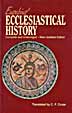 The
regulation history of Christian origins was written
by a Roman Catholic bishop.
The
regulation history of Christian origins was written
by a Roman Catholic bishop.
It ain't so. Why it ain't so is what POCM is about. |
 What's
the bottom line?
What's
the bottom line?
|
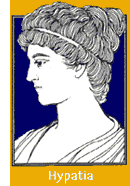 Alexandria,
Egypt. 415 AD
Alexandria,
Egypt. 415 AD|
The rioters close in, jamming Hypatia's chariot to a stop, grabbing her, jerking her down and out into the street where eager hands strip the woman naked. Jeering they drag her to a church where Christian officials promptly butcher her. Gibbon describes > |
"[H]er
flesh was scraped from her bones with
sharp oyster shells, and her quivering
limbs were delivered to the flames."
|

So why mention the murder of Hypatia? Because her story helps answer the question you're already thinking: "OK, if Christianity had Pagan origins, how come I never heard about it?" History is written by the winners. You've never heard about the Pagan origins of Christianity because as Christians institutionalized the Church starting in the 300s AD, their reaction to Pagan competition was to deny and suppress Pagan teaching. To burn Pagan writings. To drive dissident communities into the desert. To murder Pagan scholars. It worked well. So well that the word Pagan is a pejorative. So well that much of our modern understanding of these faiths is available only because scholars have reconstructed Pagan theology by reading between the lines of anti-Pagan Christian propaganda—the original Pagan literature having been lost in the bonfires of suppression. You know the Christian version of the history of religion because the Paganism was suppressed. |
|
|||||||||||||
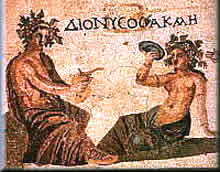 The
meaning of "pagan" as "non-Christian"
was invented by Christians. It
happened like this: Christianity's watershed political
success was in the city of Rome, with the conversion
of the emperor Constantine in
The
meaning of "pagan" as "non-Christian"
was invented by Christians. It
happened like this: Christianity's watershed political
success was in the city of Rome, with the conversion
of the emperor Constantine in this
"non-Christian ancient religion" meaning of "Pagan"
—without the "hick" nuance—is the one I
have in mind. When you and I talk about Christianity's "Pagan"
origins, we'll be talking about
this
"non-Christian ancient religion" meaning of "Pagan"
—without the "hick" nuance—is the one I
have in mind. When you and I talk about Christianity's "Pagan"
origins, we'll be talking about 
| |
|
Good Books for this section
| The River
Of God
|
What you'll find:
If this book had been around in 1998, POCM would have been unnecessary.
|

|
|

|
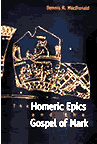
The Homeric Epic and the Gospel of Mark
|
What you'll find:
Sound nutty? Yes it does. Which is why the professor supports his thesis with oodles of ancient evidence, and a meticulous, rigorous reasoning. There's so much evidence, it's can be tough to keep going. You may well groan, "Enough already, you've convinced me!"
|
|
|
| The Historical
Evidence for Jesus |
What you'll find:
|
||||||||
|
|||||||||
|
|
|
The Jesus Puzzle by Earl Doherty
|
What you'll find:
Doherty, like professor G.A. Wells, notices that Paul and the other first century New Testament authors never give details about the Jesus of later Galillean legend. From which Doherty concludes there never was a Galillean Jesus; Christianity started wiht a mythic godman, later generations invented the earthly "history." Good use of primary sources, but this theory can only be correct if a number of odd coincidences explain away evidence that does seem most naturally to point to a real person Jesus.
|

|
|
| Drudgery
Divine
|
You'll find:
But, because Professor Smith thinks obscure is clever,
the writing is terrible. This book will not make sense until you've
read A.D. Nock's Early Gentile Christianity and Its Hellenistic
Background.
|
|
Here's a sample >> Jesus, admits Professor Smith quoting
the Christian-borrowing scholar Loisy, was a savior-God like Osiris,
Attis and Mithras. He was a god who came to earth, died, and
saves, etc. etc. from which, opines Professor Smith,
Professor Smith is famous for his anti-borrowing agenda—which is why he's quoted a lot. |
"[Jesus] was a savior-god, after the manner
of Osiris, and Attis, a Mithra. Like them, he belonged by his
origin to the celestial world; like them, he had made
his appearance on the earth; like them, he had accomplished
a work of universal redemption, efficacious and typical;
like Adonis, Osiris, and Attis he ha died a violent death,
and like them he had returned to life; like them, he
ad prefigured in his lot that of the human beings who should take part
in his worship, and commemorate his mystic enterprise; like them, he had
predetermined, prepared, and assured the salvation of
those who became partners in his passion." [Quoting A.
Loisy, The Christian Mystery, in: The Hibbert Journal, 10(1911 - 12),
51]
|
|
|
Miracles
in Greco-Roman Antiquity
|
Lousy with miracles Like chocolate chips in mama's cookies, miracles were a basic ingredient in ancient people's understanding of how the world works. Every bite—another miracle. The ancient world was lousy with miracles. Don't believe me, believe the ancients. This excellent sourcebook gives hundreds of examples—250 pages—of ancient miracles recorded by the pens of ancients themselves. You'll read short excerpts from ancient texts describing Pagan Gods who healed the sick (blindness, paralysis, lameness), raised the dead, exorcised demons, controlled nature, turned water into wine, walked on water, calmed storms, and more. Well organized, easy to read. Highly recommended.
|

|
|
|
Life After Death by Alan Segal
|
What you'll find:
|
|
|
| Born Divine
|
What you'll find:
|
|
|
| Hellenistic
Mystery Religions
|
What you'll find:
|
|
|
| The Mysteries
|
What you'll find:
Not a good introduction. Worth reading if you're an advanced student.
|
|
|
|
The Homeric Epic and the Gospel of Mark
|
What you'll find:
Sound nutty? Yes it does. Which is why the professor supports his thesis with oodles of ancient evidence, and a meticulous, rigorous reasoning. There's so much evidence, it's can be tough to keep going. You may well groan, "Enough already, you've convinced me!"
|
|
|
| Eusebius'
Ecclesiastical History
|
What you'll find:
|
|
|
The
Gospel and the Greeks
|
What you'll find:
Because he was a Christian writing for other Christians, Nash (who seems like a smart, likable fellow) was able to write an apologist genre book—one whose tendentious reasoning betrays no expectation of unfriendly critical analysis. His analysis was basically: 1. To ignore similar fundamental ideas (soul, heaven, salvation, godman), and to attack outdated mid-20th century Jesus as a myth-by-myth analogue theories, 2. To bring up differences between Pagan myths and Christian myths, and then apply the apologists' difference-proves-no-borrowing rule.
|
|
|
| Early Gentile
Christianity and Its Hellenistic Background
|
You'll find:
First published in 1928 and reissued and updated in 1964,
this is the canonical refutation of the late 19th and
early 20th century scholarly claims that Christianity borrowed
from Paganism. This essay is widely cited as an authority, "Dr.
Nock has refuted the German School. . .", and the arguments Nock
developed here are the same ones believers use today.
|
 |
Nock was a Harvard professor who read and understood the scholarship. He did not—could not, in that generation when scholars knew better—deny the deep similarities between Christianity and the Pagan mysteries. For example >> |
The Eucharist ...
is in line with contemporary mysteries, which purported to represent the
sufferings and triumph of a god, in which his worshipers sympathized and
shared....The Eucharist
is a mystery, as mysteries were then understood, and Christianity, the
heir of Judaism, has also an essential spiritual continuity with Hellenistic
religion.
|
|
|
Nock was also a committed Christian, a Doctor of Divinity who wasn't about to admit Christianity borrowed from Paganism, so for every similarity he comes up with a reason the similarity doesn't count. The 1964 Harper Torchbook edition is expanded
with Nock's later thoughts and arguments. It is out of print, but often available used through Amazon
|
|
|
| The Quest
of the Historical Jesus
 |
What you'll find:
You can't understand 20th century scholarship NT scholarship unless you read this famous and influential book.
|
|
|
| |
|