|  |
||||||||||||||||||||||||||||||||
 |
|||||||||||||||||||||||||||||||||













| Facts > Getting Started > Civic Religion | |||
 |
Civic Religion |
Sources |
 |
Ancient religion: different from your religion |  |
|
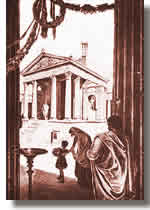
Ancient religion wasn't like our religion. Civic religion, whose magic beings make it look to us like "religion", was mostly about controlling the world by bargaining with the god-beings—hardly a function of "religion" at all, as we see it. Philosophy was about ethics and morality, but it didn't have revelation, so to us it doesn't look like religion at all. |

|
What you're about to see is that ancient religion was functionally different from our religion. It served different purposes. Our religion has been squeezed down to where it's mostly about morality and salvation. Ancient religion did those, but it also did other stuff. Which is why it's smart to separate ancient religion into parts. Like so...
|
 Ancient
religion was different from ours, but not the way you probably
think. If you're like most people, you see the main difference as we've
got one
Ancient
religion was different from ours, but not the way you probably
think. If you're like most people, you see the main difference as we've
got one |
We'll talk about Civic Religion now. We'll hit Philosophy and Mystery religion on the next two pages. Civic Religion And because their god-beings caused so much of what happened, the ancients were able to control the world by bartering with the god-beings. In that way the purpose and function of ancient religion was qualitatively different from ours. |
|

|
The Theory . |
By the way |
|
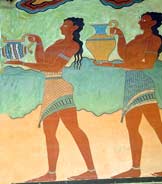
Ancient god-beings had powers and abilities far beyond those of mortal men, but their powers were superhuman, NOT super-natural. See, the ancients' faith was greater than ours. Their Gods weren't sissy spiritual phantoms lurking some imaginary place no one can see or go to. Their Gods were elements of nature, real beings living real (eternal) lives in the real world. |
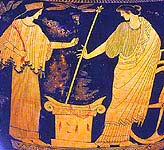
What nice things could people do for the Gods? Pour "libations" of wine. Sacrifice animals at the God's altar. The intellectuals weren't exactly sure how it worked, but when you burned parts of an animal, the Gods liked—some people said they were nourished by—the smoke from the altar fire. |
| Here's a bit
from Homer's poem the Iliad,
written down in maybe the eighth century BC. When the Greek fellows
burned lambs for the God Apollo >> 
|
No, come, let us ask some holy man ... who can tell why Phoibos Apollo is so angry, if for the sake of some vow, some hecatomb [sacrifice] he blames us, if given the fragrant smoke of lambs, of he goats, somehow he can be made willing to beat the bane aside from us.' |
Homer,
Iliad, 1.62 ... 67 (8th century BC), -- which you can find in: Lattimore,
Richmond. The Iliad of Homer (1951 / 1961),
|
|
Happy Utnapishtim sacrificed to the
Gods. >> |
I put out and released
a raven. |
| Epic of Gilgamesh,
11th tablet (early second millennium BC), -- which you can find in:
Dalley,
Stephanie. Myths From Mesopotamia; Creation, The Flood, Gilgamesh, and Others
(1989 / 2000), pg. 113- 4]
|
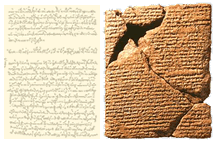 After
the "Babylonian Noah," a guy named Utnapishtim,
had survived the Gods-sent flood that wiped out humanity, but before
he'd spotted land from the ark the Gods had told him to build, he sent
out birds. At first the birds came back. Then one didn't. Hurray, said
Utnapishtim, that means "Dry land!"
After
the "Babylonian Noah," a guy named Utnapishtim,
had survived the Gods-sent flood that wiped out humanity, but before
he'd spotted land from the ark the Gods had told him to build, he sent
out birds. At first the birds came back. Then one didn't. Hurray, said
Utnapishtim, that means "Dry land!" |
Happy Noah sacrificed to the God
|
Genesis 8:20 Then
Noah built an altar to the LORD,
and took of every clean animal and of every clean bird, and offered
burnt offerings on the altar.
|
|
Old Testament, Genesis Chapter 7 |
 After
the Bible-onian Noah, a guy named Noah, had survived
the God
After
the Bible-onian Noah, a guy named Noah, had survived
the God|
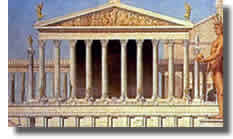
Sacrifices were common practice throughout the ancient world, dating back to prehistoric times. Occasionally the sacrificed animal was burned up entirely ["holocaust"], but generally the God got the non-tasty bits like the guts, and maybe a good part or two, like a thigh, and people ate the rest. It worked like that in Rome, in Athens, in Egypt, and at the Jewish temple in Jerusalem. The Jew's tribal God Yahweh was a sacrifice-smelling temple God, but Jesus wasn't. We're getting a bit far from POCM's theme. If you'd like to know more about the mechanics of civic temple sacrifice religion, go to these good books. |
By the way |
|
|
 The
Practice
The
Practice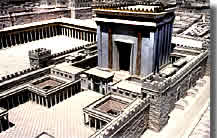 In 167 BC Judea's foreign ruler, a guy named Antiochus Version 4.0,
forced the
In 167 BC Judea's foreign ruler, a guy named Antiochus Version 4.0,
forced the |
Let's talk more about how the ancients' ideas of cause and effect shaped their civic temple-sacrifice religion. Lots of Gods; one religion. The point of civic religion was to get the Gods' help. Your household "lars" God helped you because you sacrificed to Him in the morning, not because you didn't sacrifice to Jupiter in the afternoon. And none of the Gods cared whether the stories you believed about them were precisely correct. Temple visitors wrote about having different priests tell them contradictory versions of a God's myth—at the same temple, on the same visit! |
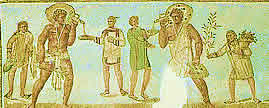 There
were lots of people, lots of tribes, lots of cities, lots of
events to explain. It made sense there had to be many agencies—many
Gods, many demigods, many spirits, etc.—to cause many
events. The ancients had lots of Gods, but one religion.
There
were lots of people, lots of tribes, lots of cities, lots of
events to explain. It made sense there had to be many agencies—many
Gods, many demigods, many spirits, etc.—to cause many
events. The ancients had lots of Gods, but one religion. Gods helped people. People were happy to get help wherever they could. Initiates in the the mysteries of Dionysus could and did simultaneously belong to the mysteries of Isis—and the mysteries of Mithras, and the mysteries of Attis. At the Temple of Jupiter, in downtown Rome, believers honored not just Jupiter, but Serapis, or Dionysus, or Mithras—and no one complained. Of course not. Complaining would have made no sense. People even sacrificed to Unnamed Gods, just to be sure.
There were intricate rules of religion, but they were about getting the mechanics of sacrifice just right, to be sure the God was pleased. We'll see later that ancient philosophical-religion cared about doctrine. But not civic religion. |
|
You didn't have
to sacrifice to every God. Some Gods demanded worship that was to bizarre
or disgusting to be worth the trouble. The city of
Rome did outlaw some sects.
Christians were banned because their atheism (they denied the divinity of the Pagan Gods) threatened the public order. The Pagan ancients persecuted religions for cultural or political reasons; they didn't persecute false doctrine. |
| So
what? So syncretism
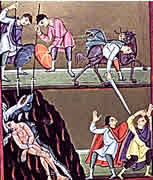
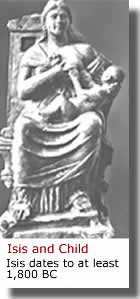
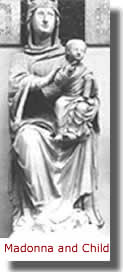
The Romans conquered the Greeks and, you know this, adopted and adapted the Greek religion as their own. The Romans borrowed from the Greeks, and rebuilt their religion from old parts. Borrowing and rebuilding happened on a local level too. Cybele
and Attis are both famous for having priests, called
Galli, who cut off their own testicles as an act of religious devotion.
But the Goddess Atargatis also had castrated priests,
and so did the God Ma. Ancient religion was fluid and
adaptive. Over and over, ritual and myth and theology passed between
peoples and cultures. Over and over, people rebuilt their religion from
old parts.
|
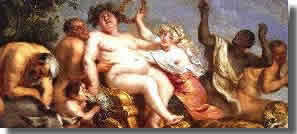 Another
example: Nowadays we associate frenzied, wine-drunk ecstasies with the
God Dionysus ("Bacchus" in Rome)—and
we're right. But other Gods were worshiped with similar rituals, including
the Thracian Sabazius (beer, instead of wine), and
the eastern Corybas (associated with the Goddess Cybele),
whose sacred possession is called "Corybantism." Even Isis
and Cybele were worshiped with wild dancing. Ancient religion
was fluid and adaptive. Over and over, ritual and myth and theology
passed between peoples and cultures. Over and over, people rebuilt their
religion from old parts.
Another
example: Nowadays we associate frenzied, wine-drunk ecstasies with the
God Dionysus ("Bacchus" in Rome)—and
we're right. But other Gods were worshiped with similar rituals, including
the Thracian Sabazius (beer, instead of wine), and
the eastern Corybas (associated with the Goddess Cybele),
whose sacred possession is called "Corybantism." Even Isis
and Cybele were worshiped with wild dancing. Ancient religion
was fluid and adaptive. Over and over, ritual and myth and theology
passed between peoples and cultures. Over and over, people rebuilt their
religion from old parts. | |
|
Good Books for this section
| Greek Religion
| What you'll find:
This book is organized by feature- of- religion: ritual, the Gods, Heroes, the dead, polytheism, the mysteries, and philosophy-religions. That gives you a compare and contrast look at, for e.g. baptism or, blood sacrifice across the culture. So the book complements the cult by cult organization of Finegan and Turcan.
|



|
|

|
The Cults of the Roman Empire
|
What
you'll find:
Like Finegan's book the power of this book is that it isn't aimed at proving a connection between paganism and Judeo-Christianity—so you're sure the author isn't skewing things to fit that argument. This book is more detailed than Finegan's—giving Highly recommended.
|

|
|
|
Myth and Mystery
|
What
you'll find:
The power of this book is that it isn't aimed at proving a connection between paganism and Judeo-Christianity—so you're sure the author isn't skewing things to fit that argument. Yet you'll read about flood and creation myths paralleling Noah and Adam, about pre-Christian ideas of the immortality of the soul and life after death, and about lots and lots of Gods who die and are reborn.
|
|
|
Isis
and Osiris
|
This is the same Plutarch who wrote Plutarch's Lives. Like Solon, Plato and Pythagoras before him, when he wasn't biographying Plutarch traveled to Egypt and studied the mysteries of Isis and Osiris—probably even got initiated (though he doesn't say for sure). Isis and Osiris, at just over 90 pages, is modern scholarship's main source for the goodies on one of the ancient world's big name Pagan religions. This Loeb translation is pretty easy to read. And fun. You'll discover "accounts of the dismemberment of Osiris and his revivification and regenesis" [Isis and Osiris, 365]—His death and resurrection! Wow. Be careful, there are a bunch of P's Moralias in print at Loeb and elsewhere. For Isis and Osiris, you want number V, which is Loeb #306.
|
|
|
|
Prolegomena to the Study of Greek Religion
|
What
you'll find:
Way too advanced to be a good first book, but fine for the advanced student. Still widely cited and still in print --because it is very good.
|
|
|
|
Religions of Rome
Religions of Rome
|
What
you'll find:
Highly recommended.
|
|
|
|
The Gods of Ancient Rome
|
What
you'll find:
|
|
|
|
The Greeks and the Irrational
|
What
you'll find:
First published in 1951 and still in print—because it is very very good.
|
|
|
|
The Orientalizing Revolution: Near
Eastern Influence on Greek Culture in the Early Archaic Age
|
What
you'll find:
Dr. Burkert's standards for Pagan borrowing turn out to be a bit different from the standards he uses elsewhere to find—or avoid finding—later Christian borrowing.
|

|
|
| Backgrounds
of Early Christianity
|
An outstanding
book to start with.
If you need a special-purpose book to understand Christianity's Pagan origins, then probably Christianity didn't have Pagan origins. It does; you don't. What you really need is a good book describing ancient Pagan culture and religion. This outstanding, easy to read book is the best I've read. From Greco-Roman religions (Mithras, Isis, Dionysus, Eleusis, the mystery religions, etc.) and philosophies (monotheism, the soul, life after death, etc.), on through an excellent section on Second Temple Judaism and another on early Christianity, you'll discover the facts and issues behind modern scholarship on Christian origins. I bought this book on a whim, figuring it would have a relevant section or two; I ended up reading the thing cover to cover, 600 delightfully clear and well written pages. But you don't have to read it cover to cover—just pick the section you're interested in.
|
|
|
| Asclepius
 |
What you'll find:
Primary evidence assembled in the 1940s, still in print because no one since has done better.
|
|
|
|
|
|