|  |
||||||||||||||||||||||||||||||||
 |
|||||||||||||||||||||||||||||||||













| Reasons > Scholarship > Con: Reverend Arthur Darby Nock |
| Scholar or Myth maker? | Yes! | History of Scholarship | Amateur Scholarship | |
| Con: J. Z. Smith | Con: AD Nock | Con: BM Metzger | Sourcebooks | |
| Con: Habermas |
 |
What,
you thought I was making this up? |
 |
|
A review of Dr. Nock's reasons. Lots of kettle logic. |
|
Believers
in their own words |
| Here's how Doctor of Divinity A. D. Nock puts it in the believers' canonical "refutation" of Christian- Pagan syncretism >> "Much" of what we know about the Pagan mystery religions dates from the third or forth centuries, asserts Dr. Nock expansively, pointing a finger and slurring his speech ever so little, and by then Paganism was "probably" assimilating Christian ideas. Dr. Nock apparently doesn't need much—any—analysis to see Pagan borrowing. Borrowing is conceivable; therefore borrowing is "probable" and "obvious." QED. Who's ready for lunch? |
|
||||||||
| But right away Doctor of Divinity Nock lets on that his standard for accepting Christian borrowing is just a teensy bit different. I use "teensy" here in its inter-galactic astronomical sense. For Christian borrowing we must
And, says Doctor of Divinity Nock, it is impossible to know all those things!! >> So, according to Doctor of Divinity Nock himself, his criteria make it impossible to discover Christian borrowing from Paganism. |
The
greatest caution must therefore
be exercised in determining what was the precise
character of any particular mystery which might be supposed to
have influenced [pg 59] Christianity in the first century ; we
need in effect to know its
character at the point of contact, since it is unsafe to assume
that there would be complete uniformity in any such cult wherever practiced
(we know that later this was certainly not so with Mithraism, which
varied in details from East to West). Further, we require some means
of estimating not merely in what
cities a particular mystery was observed, but what the local
intensity was, whether it
was for instance impossible for any man in those parts to be unaware
of its more characteristic features, or at any rate of its existence.
To all these questions there cannot be complete and satisfactory
answers . |
 Much
of what we know of the
Much
of what we know of the 

Doctor of Divinity Nock's analysis uses different criteria to identify Pagan and Christian borrowing. Pagan borrowing that is conceivable is "obvious." Christian borrowing is always—always!—excluded by Doctor of Divinity Nock's analysis.
Doctor of Divinity Nock's analysis fails because it is designed to make Christian borrowing impossible. |

 We've
been sitting in a wagon with no wheels. When your analysis
makes it impossible to discover borrowing, and then you don't
discover borrowing, the only real information in that "no borrowing"
result is that your analysis was designed not to work. When you sit
is a wagon with no wheels, you always go nowhere.
We've
been sitting in a wagon with no wheels. When your analysis
makes it impossible to discover borrowing, and then you don't
discover borrowing, the only real information in that "no borrowing"
result is that your analysis was designed not to work. When you sit
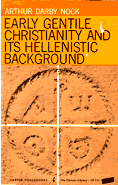
is a wagon with no wheels, you always go nowhere.Remember, I'm not telling you about Doctor of Divinity Nock because I think his analysis is weak. I'm showing you what he wrote because on the subject of Christian borrowing from Paganism, Doctor of Divinity Nock is the most famous, most admired, most cited, most quoted anti-borrowing scholar there is. And this book, Early Gentile Christianity and its Hellenistic Background is the most famous, most admired, most cited, most quoted anti-borrowing book anybody anywhere ever wrote on the subject. |
| Early Gentile
Christianity and Its Hellenistic Background
|
You'll find:
First published in 1928 and reissued and updated in 1964,
this is the canonical refutation of the late 19th and
early 20th century scholarly claims that Christianity borrowed
from Paganism. This essay is widely cited as an authority, "Dr.
Nock has refuted the German School. . .", and the arguments Nock
developed here are the same ones believers use today.
|
  |
Nock was a Harvard professor who read and understood the scholarship. He did not—could not, in that generation when scholars knew better—deny the deep similarities between Christianity and the Pagan mysteries. For example >> |
The Eucharist ...
is in line with contemporary mysteries, which purported to represent the
sufferings and triumph of a god, in which his worshipers sympathized and
shared....The Eucharist
is a mystery, as mysteries were then understood, and Christianity, the
heir of Judaism, has also an essential spiritual continuity with Hellenistic
religion.
|
|
|
Nock was also a committed Christian, a Doctor of Divinity who wasn't about to admit Christianity borrowed from Paganism, so for every similarity he comes up with a reason the similarity doesn't count. The 1964 Harper Torchbook edition is expanded
with Nock's later thoughts and arguments. It is out of print, but often available used through Amazon
|