|  |
||||||||||||||||||||||||||||||||
 |
|||||||||||||||||||||||||||||||||













| Getting Started | |||
| Scholars argue> | Yes | No | Jesus Theories |
| Facts > | Sourcebook Anthologies | Sourcebooks: ancient texts | |
| Background > | Ancient Civilization | Ancient Religion | Early Christianity |
 |
Special topics | Mystery Religions | Ancient Judaism |
| Amateur > | Pagan Origins | Hablo Greek-o | |
 |
Early
Christianity: background and sourcebooks |
 |
  |
| Backgrounds
of Early Christianity
|
An outstanding
book to start with.
If you need a special-purpose book to understand Christianity's Pagan origins, then probably Christianity didn't have Pagan origins. It does; you don't. What you really need is a good book describing ancient Pagan culture and religion. This outstanding, easy to read book is the best I've read. From Greco-Roman religions (Mithras, Isis, Dionysus, Eleusis, the mystery religions, etc.) and philosophies (monotheism, the soul, life after death, etc.), on through an excellent section on Second Temple Judaism and another on early Christianity, you'll discover the facts and issues behind modern scholarship on Christian origins. I bought this book on a whim, figuring it would have a relevant section or two; I ended up reading the thing cover to cover, 600 delightfully clear and well written pages. But you don't have to read it cover to cover—just pick the section you're interested in.
|


|
|
Gospel Truth
|
Instead of pushing his own theories and opinions, Shorto describes the spectrum of modern scholarly opinion, from Jesus-is-a-myth to the-gospels-are-history. You get the names leading scholars in each camp, with a synopsis of their opinions—a great aid to your further reading. Absolutely the best introduction to modern New Testament scholarship, because it's written not by a scholar with an opinion to sell, but by an interested but dispassionate professional magazine writer who researched all sides of the issue and who knows how to write clearly. The result is a clear and easy to read overview of modern New Testament scholarship, from Old Testament prophecy through resurrection and on to how modern pastors include, or ignore, NT scholarship in their daily ministry.
|


|
|
Ancient Judaism and Christian Origins
|
What
you'll find:
Christianity, says Nickelsburg, got its key theologies from intertestamental Judaism. This evidenced-based analysis should make apologists less happy than you'd think, since 1) It explains Christian ideas as flowing not from Jesus' revelation, but from the local culture. 2.) Pagan Origins wise, it's a distinction without a difference. Christianity got 'em from Judaism. Judaism got 'em from Paganism.
|

|
|
| 1 Enoch |
What you'll find:
Enoch is a Jewish hero who gets just a line or two in our Old Testament. In intertestamental Judaism his legend was puffed up with new myths that sound right familiar to folks who've read the Bible. Adds plausibility to the theory that the Jesus stories are
mythic elaborations of old Jewish legends (Isaiah).
|
|
|
Introduction
to the New Testament
|
This book is a treasure—an excellent place for new students to start and a valuable reference if you already know plenty. A clearly written, readable roundup of modern New Testament scholarship by a giant in the field. Includes the history of who wrote what, when—and who copied from whom. Not just the canonical books, but also Q, the Gospels of Thomas, Hebrews, etc. etc. Wow. Also details the history of which sects developed in each region, when. Not what you learned in Sunday school. Highly recommended for any serious student.
|
|
|
| The
Canon of the New Testament Its Origin, Development, and Significance by Reverend Bruce M. Metzger
|
What
you'll find:
A clear and concise introduction to conservative scholarship's version of how the New Testament got to include the books it does. Full of useful information. Not nearly as thorough or complete as Koester's volume II -- which may be a good thing, if you're just after the basics.
|

|
|
| The Life
of Jesus Critically Examined
|
What you'll find:
|
|
|
|
Ancient Christian Gospels Their History and Development
|
Do you know the oldest surviving manuscript for John? How about Mark, Matthew, Luke? When were each of the gospels first mentioned by another Christian writer? What is the evidence about who wrote them? How about the Gospel of Thomas, the Egerton Gospel, the Synoptic Sayings Source, and other early non-canonical gospels? They're here too. You'll even find detailed analysis of the late first and early second century Apostolic Fathers' (Clement, Polycarp, Ignatius) gospel quotations. [Hint—there aren't any; but the Apostolic Fathers did quote gospel-like saying of Jesus from other sources.] Why does this matter? Because it shows that the gospels themselves are not reflected in any Christian records until the second half of the second century! A well written, readable, but extremely technical scholarly analysis of the early Christian writings. Too detailed for beginners, but a fascinating read for advanced students and an excellent reference.
|
|
|
|
|
For hundreds of years everyone assumed that the earliest Christians were orthodox New Testament Roman Christians, and"heretical" Christianities—like Gnosticism and Marcionism—developed later, branches off the original orthodox trunk. Then in the 1930s this German guy named Walter Bauer decided to actually look at the evidence. Imagine! What he discovered was that pretty much everywhere he looked—Syria, Palestine, Egypt, etc.—the "heresies" weren't branches off any trunk, they were the original local Christianities. And they weren't small marginal sects, they were the main local Christianities. The evidence shows that all around the Mediterranean, outside Rome, the orthodox New Testament Roman Christianity was a secondary sect, a sect that became dominant only after the conversion of Constantine gave it the advantage of Roman swords. Wow. No wonder the big boys call this as a paradigm shattering book. Scholarly and technical, especially in the tedious first section of chapter one. Stick with it, because it gets fun and exciting. Out of Print, not available at Amazon. Try a used book seller. |
|
|
| The
Gnostic Paul Gnositc Exegesis of the Pauline Letters by Elaine Pagles
|
What
you'll find:
For advanced students.
|
|
|
| Porphyry's
Against the Christians
|
What you'll find:
Porphyry if Tyre was a third century (c 232 - 305 AD) Pagan scholar. His Kata Christianon (Against the Christians), an ass-kicking look at the illogic of early Christianity, was widely read and eventually (448 BC) burned by the church. Unlike Celsus' critique, most of which survives in Origins refutation, Porphyry's work was so feared that even its refutations were burned. It survives only in "fragments," and of course people argue about which fragments are real and which aren't.
|
|
|
| Celsus
On the True Doctrine
|
What you'll find:
Celsus was a Pagan. In the second century AD he wrote a book pointing out flaws in Christianity. Of course Celsus points up the same contradictions and illogicalities in the Christian myth that people point up today. Ignore those. They aren't the point. The point is the things Celsus doesn't complain about—the things he takes for granted because they're part of his Pagan culture and his Pagan religion. Celsus doesn't attack Christians for believing in God, or in a godman, for the idea of a human soul, for Heaven or Hell or prayer or salvation or eternal life, etc., etc. Pay attention, while you read, to all the Pagan things in Christianity that Celsus doesn't attack—your ideas about Christianity will change forever. Wow. Highly recommended.
The original version of On the True Doctrine was
written in the second century AD by a Pagan guy named
Celsus. The Christains burned it; no copies sruvive. So where does this
book come from? In the third century one of the Church Fathers,
a fellow named Origen, wrote a long rebuttal (he called
it Against Celsus) that quoted Celsus idea by idea and often
word for word. Against Celsus does survive. This book uses it's long quotes
to reconstruct Celsus' book. Is it perfect? No. Is it pretty good? Yes.
|
|
|
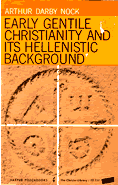
| Early Gentile
Christianity and Its Hellenistic Background
|
You'll find:
First published in 1928 and reissued and updated in 1964,
this is the canonical refutation of the late 19th and
early 20th century scholarly claims that Christianity borrowed
from Paganism. This essay is widely cited as an authority, "Dr.
Nock has refuted the German School. . .", and the arguments Nock
developed here are the same ones believers use today.
|
 |
Nock was a Harvard professor who read and understood the scholarship. He did not—could not, in that generation when scholars knew better—deny the deep similarities between Christianity and the Pagan mysteries. For example >> |
The Eucharist ...
is in line with contemporary mysteries, which purported to represent the
sufferings and triumph of a god, in which his worshipers sympathized and
shared....The Eucharist
is a mystery, as mysteries were then understood, and Christianity, the
heir of Judaism, has also an essential spiritual continuity with Hellenistic
religion.
|

|
|
Nock was also a committed Christian, a Doctor of Divinity who wasn't about to admit Christianity borrowed from Paganism, so for every similarity he comes up with a reason the similarity doesn't count. The 1964 Harper Torchbook edition is expanded
with Nock's later thoughts and arguments. It is out of print, but often available used through Amazon
|
|
|
| The Quest
of the Historical Jesus
 |
What you'll find:
You can't understand 20th century scholarship NT scholarship unless you read this famous and influential book.
|
|
|
Christianizing
the Roman Empire (A.D. 100-400)
|
A solid scholarly look at the reasons Pagans converted to Christianity in the period before Christianity took over the central government of the Roman Empire. You'd think the main tool of conversion was preaching, or maybe people telling how their conversion had changed their lives. It wasn't. The main tool of conversion was magic! The ancient evidence shows the first Christian evangelism was based on miracle working and miracle healing—basically saying 'Hey Presto! My God is stronger than your Gods.' By the end of this period about ten percent of the Empire was Christian. By a famous Yale historian. Highly recommended for serious
students.
|
|
|
| Ramsay MacMullen 
|
Continues the story of Christianizing the Roman Empire with a solid scholarly look at the reasons Pagans converted to Christianity in the period after Christianity took over the central government of the Roman Empire. Christian Roman Emperors outlawed Pagan ceremonies, taxed Pagan temples, and gave Christian Romans preferences in official advancement. By the end of this period everyone was Christian and the Empire was gone. By a famous Yale historian. Highly recommended for serious students.
|
|
|
| Eusebius'
Ecclesiastical History
|
What you'll find:
|
|
|
| Pagans
& Christians in Late Antiquity
|
What you'll find:
|
|
|
| The
Text of the New Testament
|
What
you'll find:
The New Testament you read is translated from Greek. What Greek? From a complation of Greek manuscripts, the earliest dating from the third century AD. The manuscripts do not agree, word for word, with each other. Metzger explains how your modern text is arrived at. NB. This book is not about whether the stories in the NT are true, or even where the stories came from. It is only about the texts -- the written manuscripts.
|
|
|
|
The Formation of Q
|
What you'll find:
Q is the document Matthew and Luke used as the source for many of their Jesus sayings.
|
|
|
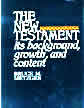
| New
Testament: Its Background, Growth and Content
|
What
you'll find:
A clear and concise version of conservative Christian scholarship telling the orthodox legend. As always, Rev. Metzger stays as rational and scholarly as possible without ever doubting the legend itself. Read this because you're interested in understanding conservative scholarship. To get a better introduction to the facts, read Everett Ferguson's Backgrounds of Early Christianity.
|
|
|