f
Christian origins gets to be your hobby,
watch out you don't get sucked in to studying
ancient Greek. It starts small. A
few letters цена экскурсии в Эрмитаж here, a diphthong there. Other
people are doing it. After all, the New Testament
was written in Greek, on account of which,
books about Christian origins often mention
words,
or quote short sentences, ,
in Greek. The unwary, undisciplined student
may be tempted to experiment with Greek, just
a few letters, to see what it's like, to sound
out the words he comes across in books.
Experts recognize this as a "gateway
activity."
Soon
the rush the student feels from sounding out
single letters no longer gives the "high"
he now craves. Many unfortunates move on to
full words and from there to "hard Greek"—strong
aorists, passive optatives, hortatory subjunctives,
and even copulas. Experienced counselors identify
victims by their vacant eyes and muttered
phrases -- "poio, poieis, poiei, poioumen."
Greek-addicted
students may support their habit by stealing
time from worthwhile activities. Women addicts
may even sink to selling their bodies —
a tragic truth proven by the Journal
of Athenian Criminology, 1983, 3 (347- 52),
in which highly smart scientist experts found
that fully ninety-three percent of
prostitutes arrested by local police
had studied Greek during
their school years. Many were
fluent in the language!
If you are tempted to experiment
with ancient Greek, consider these chilling
facts:
It is impossible to learn ancient Greek
on your own. Ninety-five percent
of people who begin studying ancient
Greek on their own quit. (I
am not making this up.) The other five
percent quit too, and lie about it.
There are many books
whose authors claim they can teach you
ancient Greek. In my opinion, these
authors are liars. Most Learn Greek
books are terrible. None
work.
Not
in Kansas any more
The thing about ancient Greek is, it is completely
strange. The way it shapes thoughts
is way different from how we do. Ancient
Greek is fucked up.
English codes thoughts with word
order; Greek codes thoughts with
word endings. The man
sees the house. We know who's seeing
and what's seen because man comes
before the verb and house after.
This scheme is so deep in our brain, we don't
even know we're doing it. See, you just did
it again. And again.
Greek says the same thing as:
The-os man-os the-on house-on see-he.
Or,
The-on house-on see-he the-os
man-os. Or The-on house-on the-os man-os see-he.
Who and what are
coded in -ons and -oss stuck on the ass end
of words. You learn to approach each sentence
looking for the -ons and -oss. You learn to
think in -ons and -oss.
Only
you can't think -ons and -oss until you learn
them all, and I've been going easy on you
ending wise. The truth is there are 24 basic
noun endings split into three groups. But
each group has sub-groups. There are hundreds
of endings. And
-os in one group means the same as -ou in
another. And in a sentence the same thing,
the man or the house, may have more than one
ending -- one ending for the 'the', another
for the thing, another for the adjective describing
the thing. You cannot read Greek till you
know hundreds of endings, and how
they work in a sentence. Greek is
fucked up.
Verbs are the same, only
worse. One time I tried counting the number
of endings a verb can have, but I fell asleep.
Use 500 as a rough estimate.
First year Greek courses boil down to learning
the endings. The reference grammar at the
back of JACT's Reading Greek Grammar
puts the endings in tables, 20 to 80 endings
per page. For each ending you have to know
not just the ending, but which table
it's in, and which row,
and which column.The thing
goes on for 52 pages.
Learn
Greek books
The guys writing Learn Greek books have a
problem: How do you get all those endings
into one book? Mostly they do it by teaching
tables, each chapter with a table or two.
I call these table books.
Some
guys add grammar rules,"The
second aorist and the second perfect are usually
formed only from primitive verbs These tenses
are formed by adding the personal endings
(inclusive of the thematic or tense vowel)
to
the verb-stem without any consonant tense-suffix."
I
call these Tables and Rules
books.
The trouble is memorizing tables is not the
same as learning to read and think Greek.
You're
still reading. You do want to learn ancient Greek! Good.
Let's talk.
Task
You can't read Greek till you know thousands
of word endings, but memorizing tables of
endings won't let you read Greek. Your task
is to do two things at the same time —
memorize tables of endings and read
sentences so you internalize the meaning of
the endings so you don't need the tables.
You gotta' get to the point "twn"
means "of the" and you're scanning
for a second person plural genitive noun because
you need to complete the thought, not because
a table you memorized tells you to. You will
not acquire this skill by reading rules.
You must learn by doing. You must
read level-appropriate Greek as you learn.
More on this later.
Time
The cover of one of my Learn Greek book promises,
"Read New Testament Greek in 10 Days!"That's a lie. Adults who
immerse themselves in the new culture say
it takes two years, full time, to master their
new language. You're going to do Greek part
time, from books. You're not going to read
the NT in ten days, not even ten months. You're
going to be plodding on your Greek for years.
Years. It's taken me two or three
years (I've lost count), off and
on, to get to where I can read a gospel
with only a little vocab help or pick up Xenophon
and get through whole sentences on my own.
Fun
Which means learning Greek —reading Greek—better be something
you like. Not the way you like to have cleaned your
toilet, the way you like to be on the beach in the sun. Fun
right now, while you're doing it. That kind of like. Otherwise,
it ain't worth the effort.
Off and on One big advantage of learning Greek on your own is, when your
brain gets full you can lay off, let things settle. Take a week,
a month, a season off. Come back when you're ready. You'll
discover the little stuff, the confusing stuff, has fallen away and
the big important stuff is now clear and obvious. My biggest progress
always comes when I pick up again after a month or three off.
Koine / Attic / Homeric
People talk like New Testament Koine Greek is way different than Attic
Classical Greek. This is a crock.
Homeric Greek (Iliad, Odyssey, Hesiod) though, is a category of it's
own.
Three
kinds of Learn Greek books
1
Tables and Rules. Memorize
word ending tables. Read pages and pages of intricate grammar
rules. T & R books generally give you no or little reading
practice, so you don't develop any recognize-endings-in-context
skills.
You're told raw facts, you're not given the skills to use them.
It's like "learning" tennis by memorizing the names
of the strokes, but never picking up a racket.
Mastronade
Most NT Greek Books
2
Tables Word
ending tables with few rules.
As with T & R books, you'll end up not able to read Greek,
and thinking it's your fault, you haven't mastered the
forms. You'll waste weeks and months going back to memorize the
principal parts of "important" verbs, and writing out
tables of obscure type 3 nouns. And simple sentences will be impenetrable
still. It's not you. It's your book.
Mounce
3
Reading,
rules and tables. Simple
Dick and Jane stories, a few hundred
words, in Greek, keyed to accompanying
grammar tables and rules.
Your must do two things at the same
time — memorize tables
of endings and internalize the meaning
of the endings so you don't need the
tables. How? Plan on two or
three passes through the material. Start
with a basic skill set.
Big picture
As
a practical matter you won't be able
to read ancient Greek without a formal
knowledge of Greek grammar. You are
going to need to puzzle out whether
this verb is aorist or pluperfect and
that noun genitive or accusative. Sorry.
That's the way Greeks minds worked.
The important thing is to understand,
the thing Learn Greek books aren't good
at pointing out, is that Greek grammar
has several levels of structure. The
books and teachers focus on the lower
levels. Ending rules, and exceptions
to the rules, and exceptions to exceptions.
You must do two things on your own.
1) Understand that there is
a big structure -- a structure
to verbs in general, a structure to
nouns in general -- and fit each new
table into that structure. Find and
understand the connections between each
table and the bigger structure.
2) Understand that exceptions to exceptions
to exceptions is a convenient way to
stuff everything into a book, but it's
a terrible way to stuff everything into
your brain. There's too much
to learn with one pass.
Simple solution. Make several passes.
Self learners set their own schedule,
so they have a big advantage here.
For verbs,
learn the standard -o verb endings in
all the tenses. Drill and practice.
Get that down. Then go back and do it
again, this time picking up the -a and
-e and u- contract verbs. Then go a
third time and pick up the odd ball
stuff. Menos, idzos, like that.
For nouns,
learn all 24 forms of "the"
absolutely cold. Write them up and down.
Write them sideways. Write them in different
gender order.
Learn the basic patterns for the three
declensions absolutely perfectly. That
means all of type 1 and 2, and the main
pattern type 3. Do not, at first, worry
your pretty head about the type 3 sub-patterns.
Drill drill drill on the basics. Write
them up and down. Write them side to
side. Know them before you move on.
If you don't know the basic declensions,
participles, say, are impossible. If
you do, participles are drop dead easy.
Ditto adjectives. Etc.
Basic
skill set
First pass
1
Gently inductive, non-stressful
introduction: Reading simple Greek
sentences in Dobson.
Nouns -- learn
the structure of Greek's noun
grammar
Masculine
Feminine
3d declension
--- very important, comes up a
lot
Verbs: Learn
the structure of Greek's verb
grammar: voice, tense, person.
Leave the subjunctive mood till
later. Do optatives later, and
only if you want to read Loebs.
Participles
— the Greek version of "-ing"
and "-ed" words. Important,
and actually not too hard, once
you understand the 3d declension
nouns. It's OK to skip participles
in pass 1.
Study JACT, or Athenaze, or Mounce.
Integrate each grammar section
with your Big Picture view from
Greg's Greek tables.
Reading practice
All
this formal stuff is useless on
it's own. Your brain treats table
entries as table entries, not
as thoughts. To recognize Greek
words as thoughts your brain needs
repetition in context. Greek sentences.
Lots of them.
The traditional way to do this
is, as I said, to sit at a desk
with a dictionary and a grammar
and to puzzle out sections of
Xenophon or Paul clause by impenetrable
clause. This works. Eventually.
But it is slow and frustrating
as hell.
The better way is to read short,
simple Greek sentences, and lots
of them. Repetition in context.
My own opinion is, it's better
to read sentences that come with
English translations. That way
you maximize repetitions. Perfect.
Since some books, even best sellers,
have essentially no Greek practice
sentences at all, and many others
have no translations, this is
is harder to do than you'd think.
Learn by doing
introduction. This should take
many weeks.
Learn
New Testament Greek by John
Dobson Tip: a very cheap used
2d edition is just as good as the full
priced 3d edition.
GOOD: Reverend Dobson's
idea was for you to learn Greek by reading
/ translating/ understanding very simple
Greek sentences. I say. He says.
Jesus says. We say. Hundreds
of cleverly constructed short Greek
sentences make this a natural,
fun, fast paced, and rewarding way to
get started.
BAD: There are not
enough sentences, or enough
context for you to "get" the
many nuances of the language. And grammar
tables are so de-emphasized you won't
notice them. You'll end up half way
up the mountain.
Starting at chapter 20,
the grammatical organization goes all
to hell.
SOLUTION: Recognize this
is an introduction. Get what you can
out of Dobson, then move on.
Pass 2, 3
Pick a Learn-Greek
Reading, Rules and Tables book,
and get to work
JACT,
Joint Association of Classical Teachers
series of college texts intended to
teach Attic (=Athenian) Greek
#1 Reading
Greek Text and Vocabulary
#2 Reading
Greek Grammar and Exercises #3An
Independent Study Guide to Reading Greek
Wow! this text is wonderful.
There are lots and lots and
lots of simple Greek stories to read,
with tons of repetition. "Yes captain,
I will go. You will go. The rhapsode
will also go. " Different endings
for each person. Over and over. Very
very useful.
Meticulously charted journey
through the larger structure of ancient
Greek grammar. Very nice.
Too advanced to be a first and only
Learn Greek book. Excellent second book.
Very useful as your second pass through
the material. I'd suggest this rather
than a second pass through Mounce.
To use any one book you must buy all
three books in the set—about $100.
Worth the money at twice the price.
NOTE: Organizes nouns
with the British N, A, G, D order.
Athenaze
is a college textbook of Attic (=Athenian)
Greek. Each chapter
begins with a one or two page
reading in ancient Greek. These
are simple, repetitious and highly instructive.
Unlike Mounce, but like
JACT, Athenaze teaches Greek a little
bit at a time. A little verb, a little
participle, a little noun in each chapter.
Because I myself need to fit each new
idea into the big picture, I find this
confusing. If you don't, you might try
Athenaze all by itself. At any rate,
once you've memorized the basic form
tables, you can breeze through Athenaze,
or even just through it's simple readings.
Very useful.
Translations are in the
separate answer book. But the readings
are so easy, you probably won't need
translations.
Answers to exercises are in the Teacher's
Handbook -- which unfortunately never
got printed in the second edition. That
makes Athenaze much less useful than
JACT.
BTW, even if you're learning
Greek just to read the NT, you'll still
find Athenaze and JACT useful for your
second pass. Yes you will have to learn
some non-NT vocabulary. So what? Also,
people blather about Attic and Koine
Greek being different. They are. But
not so much as you've been lead to believe.
Grammar reference
Basics
of Biblical Greek Grammar
by William Mounce
Mounce is famous and popular because
it clearly explains all the basic grammatical
essentials and none of the other stuff.
Organizes nouns with
the American N, G, D, A order.
GOOD: Excellent, clearly written, thorough
yet concise grammar reference.
BAD: 1. It is full of minute detail,
empty of big picture overview.
Mounce is like a jigsaw puzzle where
you memorize each tiny little word ending
piece, but you never step back and look
at the whole picture. I myself am not
smart enough to learn Greek this way.
2. Has no brain-training Greek
sentences at all. Do not be
surprised if after several months memorizing
Mounce tables you pick up a simple Greek
text and can't understand one sentence.
Mounce does sell a couple workbooks.
I found these frustrating and unuseful.
SOLUTION: Use Mounce as a reference.
Learn the grammar from JACT.
Simple
reading
Interlinear
New Testaments have the
Greek of the NT on one line, and the
English translation of each Greek word
on the line right below it.
Just cover up the English,
and read away. Even if your main interest
is Attic Greek, the practice you'll
get will be highly instructive.
Nestle-Aland
New Testament Diglot: Greek
on one page, English on the facing page.
More challenging than an interlinear,
and more satisfying.
Easier Greek than any
Loeb. An excellent way to start reading,
even if your interest is Attic Greek.
CONS: despite the title,
does not involve chocolate.
Greek
Prose Composition & Keys , by
North & Hilliard'
John White
Arthur Sidgwick
A hundred years ago ancient
Greek was a standard part of English
schoolboy education. Not only did the
wee lads read Greek, they also had to
write Greek. That's where you come in.
The 100+ year old Greek Composition
textbooks are out of copyright and available
free on the internet. They're
a handy source of free simple
Greek sentences (the keys) with English
translations (the exercises in the composition
books).
Pass 4?
Fly
little birdie, fly!
Loeb
Classical Library
The Loeb Classical Library publishes
more than five hundred titles in ancient
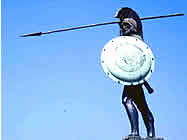
Greek. At Thermopylae,
when the certainly soon to die Dieneces
the Spartan was told the Persian
army was so vast that, shooting together,
their arrows blotted out the sun, he
laughed, "Good, then
we will advance to battle in the shade.
" With the Loeb books
you will reach back two or two and a
half thousand years and hear and understand
and feel the words and thoughts of brave,
cowardly, truthful, duplicitous, greedy,
loving, hating, living breathing mothers,
fathers, sons, and daughters, just as
they spoke them to themselves. Absolutely
fucking amazing.
The books have the Greek text
on the left page and the accompanying
English translation on the right
page. Read the Greek all on
your own; if you run into trouble, there's
quick, easy help on the facing page.
There are enough fun, delightful, fascinating,
moving books here to keep you busy for
the rest of your life. The standard
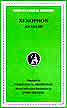
beginners book is Xenophon's
swashbuckling Anabasis.
If you're interested in Greek in NT
times, try Plutarch
and Lucian, the Apostolic
Fathers,or the Selected
Papyri-useses.
Unless you know for sure it is what
you want, you should avoid the temptation
to start with the very old Greek of
Homer, Hesiod, and
Pindar, etc. That
way lies madness.
Basic Greek
In 30 Minutes per Day New Testament Greek Workbook for Laymen
by James Found
What
you'll find:
Gentle, easy introduction to Greek letters, pronunciation,
and rudimentary New Testament vocabulary.
Why you won't learn Greek
from this book.
Beyond the basics, the material is too thin.
This is a good first Greek book if what you're after is
the alphabet and sounding out and recognizing words. It doesn't take you
far, but you'll travel in solid, unstressed comfort.
Anabasis
by Xenophon
What
you'll find:
Swashbuckling
first person true adventure story of the Greek mercenary army's
long march out Persia, under enemy attack, after picking the wrong
side in an attempted coup.
The traditional first
book for new classical Greek students. Clear, direct sentences.
Mostly present, imperfect and aorist tenses. Not easy, but not as
hard as lots of other stuff.
The Loeb addition has Greek
on the left page, the English
translation on the right page.
A famous classic you know you ought to read—and that you'll actually
enjoy.
Buy it early, read the English because it's fun, then pick it up from
time to time as you work through Dobson and Mounce. It's encouraging to
see how more and more of the text is understandable with each passing
month.
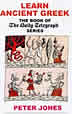
Learn Ancient
Greek
by Peter Jones
What
you'll find:
The Steve Allen of Learn Greek books.
Steve Allen was a 1950's era comedian (he started the Tonight Show)
who was, by the 1960s, painfully uncool and unfunny. But he didn't
know it. He told pathetic jokes. And giggled at them himself. He
excelled at mediocrity.
Jones' book tries hard to be clever. It isn't. It isn't bad. It's
just not good.
Why you won't learn Greek
from this book.
The goal isn't all Greek. The goal is The Greek in
This Book. You'll like that very much, if you like that sort of
thing.















 .
.
 f
Christian origins gets to be your hobby,
watch out you don't get sucked in to studying
ancient Greek. It starts small. A
few letters
f
Christian origins gets to be your hobby,
watch out you don't get sucked in to studying
ancient Greek. It starts small. A
few letters  ,
or quote short sentences,
,
or quote short sentences,  ,
in Greek. The unwary, undisciplined student
may be tempted to experiment with Greek, just
a few letters, to see what it's like, to sound
out the words he comes across in books.
,
in Greek. The unwary, undisciplined student
may be tempted to experiment with Greek, just
a few letters, to see what it's like, to sound
out the words he comes across in books. 
 Greek-addicted
students may support their habit by stealing
time from worthwhile activities. Women addicts
may even sink to selling their bodies —
a tragic truth proven by the Journal
of Athenian Criminology, 1983, 3 (347- 52),
in which highly smart scientist experts found
that fully ninety-three percent of
prostitutes arrested by local police
had studied Greek during
their school years. Many were
fluent in the language!
Greek-addicted
students may support their habit by stealing
time from worthwhile activities. Women addicts
may even sink to selling their bodies —
a tragic truth proven by the Journal
of Athenian Criminology, 1983, 3 (347- 52),
in which highly smart scientist experts found
that fully ninety-three percent of
prostitutes arrested by local police
had studied Greek during
their school years. Many were
fluent in the language!

 Only
you can't think -ons and -oss until you learn
them all, and I've been going easy on you
ending wise. The truth is there are 24 basic
noun endings split into three groups. But
each group has sub-groups. There are hundreds
of endings. And
-os in one group means the same as -ou in
another. And in a sentence the same thing,
the man or the house, may have more than one
ending -- one ending for the 'the', another
for the thing, another for the adjective describing
the thing. You cannot read Greek till you
know hundreds of endings, and how
they work in a sentence. Greek is
fucked up.
Only
you can't think -ons and -oss until you learn
them all, and I've been going easy on you
ending wise. The truth is there are 24 basic
noun endings split into three groups. But
each group has sub-groups. There are hundreds
of endings. And
-os in one group means the same as -ou in
another. And in a sentence the same thing,
the man or the house, may have more than one
ending -- one ending for the 'the', another
for the thing, another for the adjective describing
the thing. You cannot read Greek till you
know hundreds of endings, and how
they work in a sentence. Greek is
fucked up.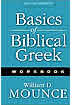

 You're
still reading. You do want to learn ancient Greek!
You're
still reading. You do want to learn ancient Greek! 
 Fun
Fun 1
1 As
a practical matter you won't be able
to read ancient Greek without a formal
knowledge of Greek grammar. You are
going to need to puzzle out whether
this verb is aorist or pluperfect and
that noun genitive or accusative. Sorry.
That's the way Greeks minds worked.
As
a practical matter you won't be able
to read ancient Greek without a formal
knowledge of Greek grammar. You are
going to need to puzzle out whether
this verb is aorist or pluperfect and
that noun genitive or accusative. Sorry.
That's the way Greeks minds worked.
 All
this formal stuff is useless on
it's own. Your brain treats table
entries as table entries, not
as thoughts. To recognize Greek
words as thoughts your brain needs
repetition in context. Greek sentences.
Lots of them.
All
this formal stuff is useless on
it's own. Your brain treats table
entries as table entries, not
as thoughts. To recognize Greek
words as thoughts your brain needs
repetition in context. Greek sentences.
Lots of them. 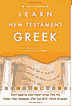 Learn
New Testament Greek by John
Dobson
Learn
New Testament Greek by John
Dobson JACT,
Joint Association of Classical Teachers
series of college texts intended to
teach Attic (=Athenian) Greek
JACT,
Joint Association of Classical Teachers
series of college texts intended to
teach Attic (=Athenian) Greek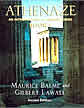 Athenaze
is a college textbook of Attic (=Athenian)
Greek. Each chapter
begins with a one or two page
reading in ancient Greek. These
are simple, repetitious and highly instructive.
Athenaze
is a college textbook of Attic (=Athenian)
Greek. Each chapter
begins with a one or two page
reading in ancient Greek. These
are simple, repetitious and highly instructive.
 Interlinear
New Testaments have the
Greek of the NT on one line, and the
English translation of each Greek word
on the line right below it.
Interlinear
New Testaments have the
Greek of the NT on one line, and the
English translation of each Greek word
on the line right below it.  Nestle-Aland
New Testament Diglot: Greek
on one page, English on the facing page.
More challenging than an interlinear,
and more satisfying.
Nestle-Aland
New Testament Diglot: Greek
on one page, English on the facing page.
More challenging than an interlinear,
and more satisfying. Greek
Prose Composition & Keys , by
Greek
Prose Composition & Keys , by
 Fly
little birdie, fly!
Fly
little birdie, fly!