|  |
||||||||||||||||||||||||||||||||
 |
|||||||||||||||||||||||||||||||||













| Facts > Pagan Ideas > Prophecy | ||||
 |
Jesus fulfilled prophecy—Pagan Gods fulfilled prophecy first |  |
What could be called more divine
than |
|
Was Christianity new? Was Christianity
unique? Pagan prophets predicted the future—correctly. You know this if you've heard of the famous oracle at Delphi. You probably also know that our word "auspicious" comes from "auspices", the Roman religious ritual where priests told the future by reading the livers of sacrificed animals. (Sheesh. Have you noticed how often other peoples' beliefs are crazy stupid?) Prophsies were like other miracles. Paganism had plenty of them, the early Christains believed in the Pagan miracles (though they often attributed them to Pagan demons). Early Christianity also had plenty of spirit filled prophets of it's own. Both Christians and Pagans understood their prophesies with the same—Pagan—ideas. |
| Reasons |
|
|
 Christian
ideas about prophesy were identical with Pagan ideas about prophesy—the
only difference was Christians believed their prophesy came from their
one true God and Pagan prophesies came from Pagan demons. Christian
ideas about prophesy come from deep in the Pagan center of ancient culture
Christian
ideas about prophesy were identical with Pagan ideas about prophesy—the
only difference was Christians believed their prophesy came from their
one true God and Pagan prophesies came from Pagan demons. Christian
ideas about prophesy come from deep in the Pagan center of ancient cultureSOP For
Paganism, prophesy was Standard Operating Procedure For
Paganism, prophesy was Standard Operating Procedure |
|
| |SOP||| | |
|

|
Why the mess? POCM 2012 |
 |
|
Jews too
|
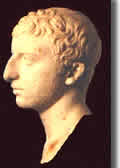
"the signs that were so evident, and did so plainly foretell their the Jews future desolation."Josephus, Jewish War, ,6.5.288 He goes on: "Thus there was a star resembling a sword, which stood over the city, and a comet, that continued a whole year." 6.5.289 And in the Temple, "at the ninth hour of the night of the night a great light shone round the altar....This light seemed to be a good sign to the naive, but was so interpreted by the sacred scribes as to portend the events that followed." 6.5.291- 293 And, "also, a heifer, as she was led by the high priest to be sacrificed, brought forth a lamb in the midst of the temple." 6.5.292 "Moreover, the eastern gate of the inner temple. . .was seen to be opened of its own accord. This also the vulgar thought a happy prodigy...but the men of learning understood it."6.5.293 - 295 And, "...chariots and troops of soldiers in their armor were seen running about among the clouds. 6.5.298 - 299 And "Jesus, son of Ananus...came to that feast whereon.. everyone makes tabernacles to God in the temple...and began on a sudden to cry aloud, "A voice from the east, a voice from the west, a voice from the four winds, a voice against Jerusalem and the holy house." 6.5.300- 301 |
|
So strong was the Pagans' faith, they institutionalized prophecy-miracles with professional prophesy-readers—guys with training and text-books, guys you'd consult like you consult a doctor. Ask a question, the prophecy-guy would find it on his list, apply his divine-seer skills, and foretell your future for you. Very comforting. How do we know this? We have the prophecy books they used. > > Professor Lee describes:
|
Questions to an oracle: 
|
 |
They saw that what both the fearful and the hopeful
needed and wanted the most was knowledge
of the future, that this was the reason Delphi
and Delos and Carus
and Didyma had ages ago become
rich and famous; men, because of the two tyrants I mentioned, hope and
fear, were forever coming to these shrines and asking to know the future,
and, in payment, the sacrificed whole hecatombs and donated ingots of
gold. After turning this discovery over in their minds and pondering
it, the partners laid plans to set
up an oracle, a seat of prophecy. So Alexander gave out oracles and made prophecies,
using a great deal of resourcefulness and combining guesswork with inventiveness. |
| Why so many prophesies? | |
| |Why
so many prophesies|| | |
|
|
What was going to happen next was nothing more that what the Pagan Gods planned to do next, so of course the Pagan Gods and their prophets knew the future. One good thing about Pagan Gods was they didn't
mind letting on what they knew about the future. So, like Pagan
miracles generally,
Pagan prophecy-miracles number in the tens of thousands. You
run out of patience before you run out of prophecy miracles. So here
at POCM, I've included enough to give you a sense of how central prophecy
was to Paganism. Need more? Just pick up Herodotus, Livy, Josephus,
or any other ancient historian. They're chock-a-block with prophecy-miracles.
Guaranteed. |

| Christians believed Pagan prophesies | |
| |||Christians
believed Pagan prophesies| | |
|
|
Delphic oracle done by demons. |
If, then, the Pythian
priestess is beside herself when she prophesies,
what spirit must that be which fills her mind and clouds her judgment
with darkness, unless it be of the same order with
those demons which many Christians cast out of persons possessed
with them? And this, we may observe, they do without the use of any
curious arts of magic, or incantations, but merely by prayer and simple
adjurations which the plainest person can use. |
|
Moreover, if it is believed not only among Christians
and Jews, but also by many others among the Greeks and Barbarians, that
the human soul lives and subsists
after its separation from the body;
and if reason supports the idea that pure souls which are not weighed
down with sin as with a weight of lead ascend on high to the region
of purer and more ethereal bodies, leaving here below their grosser
bodies along with their impurities; whereas souls
that are polluted and dragged down to the earth by their sins, so that
they are unable even to breathe upwards, wander
hither and thither, at some times about
sepulchres, where they appear as the apparitions of shadowy
spirits, at others among other objects on the ground;--if this
is so, what are we to think of those spirits that are attached
for entire ages, as I may say, to particular dwellings and places, whether
by a sort of magical force or by their own natural wickedness?
Are we not compelled by reason to set down as evil such spirits as employ
the power of prophesying—a
power in itself neither good nor bad—for the purpose of deceiving
men, and thus turn them away from God, and from the purity of His service?
|
|
Justin Martyr acknowledges Pagan miracles—says Christian miracles are similar |
For let even necromancy,
and the divinations you practise
by immaculate children, and the evoking
of departed human souls, and those who are called among the magi,
Dream-senders and Assistant-spirits
(Familiars), and all that is done by those who are skilled
in such matters--let these persuade you that even after death
souls are in a state of sensation; and those who are seized and cast
about by the spirits of the dead, whom all call daemoniacs or madmen;
and what you repute as oracles,
both of Amphilochus, Dodana, Pytho,
and as many other such as exist; and the opinions of
your authors, Empedocles and Pythagoras, Plato and Socrates, and the
pit of Homer, and the descent of Ulysses to inspect these things, and
all that has been uttered of a like kind.
Such favour as you grant to these, grant also to us, who not
less but more firmly than they believe in God; since we expect to receive
again our own bodies, though they be dead and cast into the earth, for
we maintain that with God nothing is impossible. |
|
Demons allow divination, says Origen |
4.92 In my Origen's opinion, however, it is
certain wicked demons, and,
so to speak, of the race of Titans or Giants, who have been guilty of
impiety towards the true God, and towards the angels in heaven, and
who have fallen from it, and who haunt the denser parts of bodies, and
frequent unclean places upon earth, and who,
possessing some power of distinguishing future events, because
they are without bodies of earthly material, engage in an employment
of this kind, and desiring to lead the human race away from the true
God, secretly enter the bodies of
the more rapacious and savage and wicked of animals, and stir
them up to do whatever they choose, and at whatever time they choose:
either turning the fancies of these animals to make flights and movements
of various kinds, in order that men
may be caught by the divining power that is in the irrational animals,
and neglect to seek after the God who contains all things; or
to search after the pure worship of God, but allow their reasoning powers
to grovel on the earth, and amongst birds and serpents, and even foxes
and wolves. For it has been observed by those who are skilled in such
matters, that the clearest prognostications are obtained from
animals of this kind; because the demons
cannot act so effectively in the milder sort of animals as they can
in these, in consequence of the similarity between them in point of
wickedness; and yet it is not wickedness, but something like wickedness,
which exist in these animals. |
|
But, to use the very words of Celsus, let it be
granted that "the sun, moon, and stars do foretell
rain, and heat, and clouds, and thunders," why, then,
if they really do foretell such great things,
ought we not rather to do homage to God, whose servant they are in uttering
these predictions, and show reverence to Him rather than His
prophets? Let them predict, then,
the approach of lightnings, and fruits, and all manner of productions,
and let all such things be under their administration; yet we shall
not on that account worship those who themselves offer worship, as we
do not worship even Moses, and those prophets who came from God after
him, and who predicted better things than rain, and heat, and clouds,
and thunders, and lightnings, and fruits, and all sorts of productions
visible to the senses. Nay, even if sun, and moon, and stars were able
to prophesy better things than rain, not even then shall we worship
them, but the Father of the prophecies which are in them, and the Word
of God, their minister. But grant
that they are His heralds, and truly messengers of heaven, why, even
then ought we not to worship the God whom they only proclaim and announce,
rather than those who are the heralds and messengers? |
|
Origen acknowledges pagan prophesies
|
In the next place, miracles were performed
in all countries, or at least in many of them, as Celsus himself
admits, instancing the case of Asclepius,
who conferred benefits on many, and who foretold
future events to entire cities, which were dedicated to him,
such as Tricca, and Epidaurus, and Cos, and Pergamus... |
|||||||||



|
Celsus mentions a multitude of Pagan oracles |
Celsus goes on to say of us: "They Christians
set no value on the oracles
of the Pythian priestess,
of the priests of Dodona,
of Clarus, of Branchidae,
of Jupiter Ammon, and of a
multitude of others; although under their guidance we
may say that colonies were sent forth, and the whole world peopled. |
|
Origen admits the oracles are real, but says: demons! |
the Christian father Origen
replies |
|
Maxentius told: this day an enemy of Rome will perish |
44.7 Discord arose in the city and the emperor
Maxentius was upbraided for abdicating responsibility…..
44.8 Disconcerted by this cry, he curried away and, summoning some senators,
he ordered the Sibylline books to be consulted. In them was found the
statement that on that day the enemy
of Rome would perish. |
|
Christianity borrowed the Pagan notion of SibyllineOracles |
In pagan
times the oracles and predictions
ascribed to the sibyls were carefully collected and jealously
guarded in the temple of Jupiter Capitolinus, and were
consulted only in times of grave crises. Because of the vogue enjoyed
by these heathen oracles and because of the influence they had in shaping
the religious views of the period, the Hellenistic
Jews in Alexandria, during the second century B.C. composed
verses in the same form, attributing them to the sibyls, and
circulated them among the pagans as a means of diffusing Judaistic doctrines
and teaching. This custom was continued down into Christian times, and
was borrowed by some Christians
so that in the second or third century, a new class of oracles
emanating from Christian sources came into being. Hence the
Sibylline Oracles can be classed as Pagan, Jewish, or Christian.
|

| Christian prophesies | |
| ||||Christian
prophesies | |
|
|
Celsus describes Christian's filled with the holy spirit |
However, let us see what he the Pagan Celsus
considers the most perfect kind of prophecy among these nations. "There
are many Christians,"
He says, "who, although of no name, with the greatest facility
and on the slightest occasion, whether within or without temples, assume
the motions and gestures of inspired
persons; while others do it in cities or among armies, for the purpose
of attracting attention and exciting surprise. These are accustomed
to say, each for himself,
'I am God; I am the Son of God; or, I am the Divine Spirit; I have come
because the world is perishing, and you, O men, are perishing for your
iniquities. But I wish to save you, and you shall see me returning again
with heavenly power. Blessed is He who now does me homage. On all the
rest I will send down eternal fire, both on cities and on countries.
And those who know not the punishments which await. them shall repent
and grieve in vain; while those who are faithful to me I will preserve
eternally.'" Then He goes on to say: "To these promises
are added strange, fanatical, and quite unintelligible words,
of which no rational person can find the meaning: for so dark are they,
as to have no meaning at all; but they give occasion to every
fool or impostor to apply them to suit his own purposes." |
|
Second century Christian prophetess |
in the period after the emperor Alexander Severus
(193 - 211 AD)... There were numerous frequent earthquakes…
some towns were even swallowed up by cracks opening in the ground and
taken down to the depths. …. |
|
And while he Polycarp
was praying he fell into a trance
three days before his arrest, and he saw his pillow being consumed by
fire. And he turned and said to those who were with him: "It
is necessary that I be burned alive." |
| |
44.5 Constantine
was enjoined in a dream
to mark the heavenly symbol of God on the shields of his men
and so to engage in battle. He did as commanded, and marked
Christ on the shields in the form of a letter X placed sideways with
the top bent around. |
| Examples | |
| |||| |Examples |
|
 |
Oracles |
|
Omens |
|
Prodigies |
|
Dreams |
|
Divination |
|
Auspices |
| Prophesies | |
| |
|
|
Pythagoras had the power of God in him. How do we know this? His prophecies always came true, that's how. >> |
The Pythagoreans are said to have predicted many things, and Pythagoras'
predictions always came true. |
|
'Cause I'm sure you're dying to know, here's the Pythagorean's theology about how prophecy worked >> |
The Pythagoreans
also assert that the whole air is
full of souls, and that these are those that are accounted daimons
or heroes. They are the ones that send down among men dreams, and tokens
of disease and health; the latter not being reserved to human beings,
but being sent also to sheep and cattle as well. They are concerned
with purifications, expiations, and all kinds of divinations,
oracular predictions, and
the like. |
| Christian prophets foretold the future. Pagan prophecy readers and Sibyls and the Pythian priestess and the priests of Dodona and Clarus and Branchidae and Jupiter Amon and a multitude of others and Pythagoras and his disciples foretold the future first. |
|
Apollonius had the power of prophecy
>> |
For the circumstance that Apollonius
foresaw and foreknew so many things does not in the least justify
us in imputing to him this kind of wisdom black magic; we might as
well accuse Socrates of the
same, because, thanks to his familiar spirit, he knew things
beforehand, and we
might also accuse Anaxagoras
because of the many things he foretold. |

|
Christian prophets foretold the future. Pagan prophecy readers and Sybils and the Pythian priestess and the priests of Dodona and Clarus and Branchidae and Jupiter Amon and a multitude of others and Pythagoras and his disciples and the godman Apollonius of Tyana and Socrates and Anaxagoras foretold the future first. Are you seeing the pattern here? |
|
|
They saw that what both the fearful
and the hopeful needed and wanted
the most was knowledge of the future, that this was
the reason Delphi and Delos
and Carus and Didyma
had ages ago become rich and famous; men ... were forever coming
to these shrines and asking to know the future, and, in payment,
the sacrificed whole hecatombs and donated ingots of gold. After turning
this discovery over in their minds and pondering it, the
partners laid plans to set up an oracle, a seat of prophecy. |
|
|
Amphilochus, you see, after his father Amphiaraus' death and disappearance in Thebes, had been banished from his home town; he make his way to Cilicia and there came out of it all very nicely by going into oracle making himself, and foretelling the future for the Cilicians at a charge of 75 cents per prediction. Lucian, Alexander the False Prophet, 8 (2d Century AD),—which you can find in: Casson, Lionel. Selected Satires of Lucian (1962), pg. 278 |
|
"Amphiaraus
had been a seer during his lifetime. After a mysterious death (Zeus
clove the ground in front of his chariot and he was swallowed up), he
continued prophesying from a famous
shrine in central Greece. The son's oracle was located in the
town of Mallus."
|
|
|
Pretty soon Alexander
was even sending agents into neighboring lands to spread the word about
his oracle among various people. These men advertised that he offered
general prophecy,
recovery of runaway slaves, detection of thieves and bandits, discovery
of buried treasure, healing
of the sick, and, on occasion, raising
of the dead. The result was a stampede from all sides plus sacrifices
and offerings. |
|
Christian prophets foretold the future. Pagan prophecy readers and Sybils and the Pythian priestess and the priests of Dodona and Clarus and Branchidae and Jupiter Amon and a multitude of others and Pythagoras and his disciples and the godman Apollonius of Tyana and Socrates and Anaxagoras and the priests at Delos and Dymma, and Amphilochus and Amphiarus and Glycon's prophet Alexander foretold the future first. |
|
|
Be not, O Greeks,
so very hostilely disposed towards the Barbarians, nor look with ill
will on their opinions. For which of your institutions has not been
derived from the Barbarians? The most eminent of the Telmessians
invented the art of divining by dreams; the Carians,
that of prognosticating by the stars; the Phrygians
and the most ancient Isaurians,
augury by the flight of birds; the Cyprians,
the art of inspecting victims. |
|
Christian prophets foretold the future. Pagan prophecy readers and Sybils and the Pythian priestess and the priests of Dodona and Clarus and Branchidae and Jupiter Amon and a multitude of others and Pythagoras and his disciples and the godman Apollonius of Tyana and Socrates and Anaxagoras and the priests at Delos and Dymma, and Amphilochus and Amphiarus and Glycon's prophet Alexander and the nation of the Greeks, and the nation of the Telmessians, and the nation of the Carians and the nation of the Phyrgians, and the nation of the Isaurians and the nation of the Cyprians foretold the future first. Are you seeing the pattern here? Prophecies made and prophecies fulfilled were basic to Paganism. I promised we'd run out of patience before we ran out of prophecies. And so we have. |
| Oracles | |
| |
|
|
Christian prophets foretold the future. Pagan prophecy readers foretold the future first. |
Sibyls = prophetesseseszz One good thing about Pagan Gods was they didn't mind letting on what they knew about the future. You could get a forecast by consulting a Sibyl. (Why "Sibyls"? Because it was easier than "prophetesseseszz." The ancients didn't have spill chuckers.) Here's the second century Christian writer Justin Martyr describing a Pagan Sybil at work >> A Sybil was a woman, a prophetess who spoke God's words for Him. There were lots of Sibyls in lots of places. A God would move the Sibyl to speak, someone would quick write down what she said and later on folks would consult her words (in Rome they kept them in them the "Sibylline Books"—you'll someday run across that term in the ancient texts) for help foretelling the future. |
The ancient Sibyl, who by some kind of potent inspiration teaches you, through her oracular predictions, truths which seem to be much akin to the teaching of the prophets. She ... uttered her oracular sayings in a city called Cumae ... And they who had heard it from their fathers as part of their country's tradition, told us that it was here she used to publish her oracles. . .. They said that she washed, and having put on her robe again, retires into the inmost chamber of the basilica, which is still a part of the one stone; and sitting in the middle of the chamber on a high rostrum and throne, thus proclaims her oracles. |
|||
| Many writers, including Plato said Justin Martyr, agreed that such prophecies were divinely inspired >>
...and that their prophecies were fulfilled >>
...because the prophetesseseszz |
And both by many other writers has the Sibyl been
mentioned as a prophetess,
and also by Plato in his Phaedrus. And Plato
seems to me to have counted prophets divinely inspired
when He read her prophecies. For He saw that what
she had long ago predicted was accomplished; and on this account
He expresses in the Dialogue with Meno his wonder at and admiration
of prophets in the following terms: "Those whom we now
call prophetic persons we should rightly name divine. And not
least would we say that they are divine, and are raised to the prophetic
ecstasy by the inspiration and possession
of God, when they correctly speak of many and important
matters, and yet know nothing of what they are saying,"--plainly
and manifestly referring to the prophecies of the Sibyl. |
|
Christian prophets foretold the future. Pagan prophecy readers and Sybils foretold the future first. |
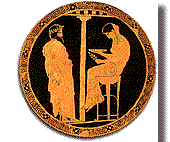
You'd figure the place a Sibyl worked would be a Sibylarium, but it wasn't. It was an oracle. The predictions she gave were also oracles. Sometimes the Sybil was called an oracle. It was fun to say "oracle," so they used it whenever they could. Try it yourself: Oracle, oracle, oracle. See? Pagans had lots of oracles,
|
Celsus goes on to say of us: "They Christians
set no value on the oracles
of the Pythian priestess,
of the priests of Dodona,
of Clarus, of Branchidae,
of Jupiter Ammon, and of a
multitude of others; although under their guidance we
may say that colonies were sent forth, and the whole world peopled. |
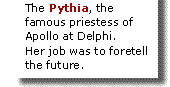
|
There are many
oracles among the Greeks, many among the Egyptians,
some in Libya, and many
in Asia. None of the others, however, speaks without
priests or prophets. This god Apollo takes the initiative
himself and completes the oracle of his own accord. This is his method.
Whenever he wishes to deliver an oracle, he first moves on his throne,
and the priests immediately lift him up. If they do not lift him, he
begins to sweat and moves still more.
When they put him on their shoulders and carry him, he leads them in
every direction as he spins around and leaps from one place to another.
Finally the chief priest meets him face to face and asks him about all
sorts of thing. If the god does not want something done, he moves backwards.
If he approves of something, like a charioteer he leads forward
those who are carrying him. In this manner they collect the divine utterances.
The god also speaks of the year and of all its seasons, even when they
do not ask. He also talks about the "Sign", when it must make
the journey I have just mentioned. I will tell something else which
he did while I was present. The priests
were lifting him up and beginning to carry him, but he left them below
on the ground and went off alone into the air. |
|
Christian prophets foretold the future. Pagan prophecy readers and Sybils and the Pythian priestess and the priests of Dodona and Clarus and Branchidae and Jupiter Amon and a multitude of others foretold the future first. |
|
Sibylline Oracles is the name given to certain collections of supposed prophecies, emanating from the sibyls or divinely inspired seeresses, which were widely circulated in antiquity In pagan times the oracles and predictions ascribed to the sibyls were carefully collected and jealously guarded in the temple of Jupiter Capitolinus, and were consulted only in times of grave crises. |
29.10… Hannibal general
of the invading army had gone into winter quarters in
Italy… 29.11 ... Accordingly, they decided to send a mission to him king Atalus, who controlled the Great Mother goddess (a meteor?)......He then handed over to them the sacred stone which the natives declared to be "the Mother of the Gods," and bade them carry it to Rome. . . |
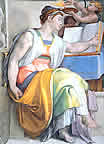 |
29.14... Two suns were said to have been seen; there were intervals of daylight during the night; a meteor was seen to shoot from east to west; a gate at Tarracina and at Anagnia a gate and several portions of the wall were struck by lightning; in the temple of Juno Sospita at Lanuvium a crash followed by a dreadful roar was heard. To expiate these portents special intercessions were offered for a whole day, and in consequence of a shower of stones a nine days' solemnity of prayer and sacrifice was observed. |
|
P. Scipio was ordered to go to Ostia Rome's port,
accompanied by all the matrons, to meet the goddess... The matrons,
each taking their turn in bearing the sacred image, carried
the goddess into the temple of Victory on the Palatine. |
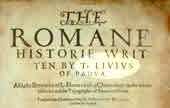 Livy
describes the
Livy
describes the |
I am Serenus, assistant to the illustrious Ptolemaios—together
with Felix and Apollonios the painter. We
have come here, in accordance with the oracles of the invincible Apollo,
to offer libations and sacrifices… to Isis. |
|
The Epidaurian images |
5.82. The ancient feud between the Aeginetans
and Athenians arose out of the following circumstances. Once upon a
time the land of Epidaurus would
bear no crops, and the Epidaurians sent to consult the oracle
of Delphi concerning their affliction. The answer bade them
set up the images of Damia and Auxesia, and promised them better fortune
when that should be done. "Shall the images be made of bronze
or stone?" the Epidaurians asked; but the priestess replied, "Of
neither: but let then be made of the garden olive." Then the Epidaurians
sent to Athens and asked leave to cut olive wood in Attica, believing
the Athenian olives to be the holiest; or, according to others, because
there were no olives at that time anywhere else in all the world but
at Athens. The Athenians answered that they would give them leave, but
on condition of their bringing offerings year by year to Athena Polias
and to Erechtheus. The Epidaurians agreed, and having obtained what
they wanted, made the images of olive wood, and set them up in their
own country. Henceforth their land
bore its crops, and they duly paid the Athenians what had been
agreed upon. |
|
13. Gyges was afterwards confirmed in the possession of the throne by an answer of the Delphic oracle. Enraged at the murder of their king, the people flew to arms, but after a while the partisans of Gyges came to terms with them, and it was agreed that if the Delphic oracle declared him king of the Lydians, he should reign; if otherwise, he should yield the throne to the Heraclidae. As the oracle was given in his favour he became king. The Pythian priestess, however, added that, in the fifth generation from Gyges, vengeance should come for the Heraclidae; a prophecy of which neither the Lydians nor their princes took any account till it was fulfilled. |
|
|
14. When Gyges
was established on the throne, he sent
no small presents to Delphi, as his many silver offerings at
the Delphic shrine testify. Besides this silver he gave a
vast number of vessels of gold, among which the most worthy of
mention are the goblets, six in number, and weighing altogether thirty
talents, which stand in the Corinthian treasury, dedicated by him. I
call it the Corinthian treasury, though in strictness of speech it is
the treasury not of the whole Corinthian people, but of Cypselus, son
of Eetion. Excepting Midas, son of Gordias, king of Phrygia, Gyges was
the first of the barbarians whom we know to have sent offerings to Delphi.
Midas dedicated the royal throne whereon he was accustomed to sit and
administer justice, an object well worth looking at. It lies in the
same place as the goblets presented by Gyges. The Delphians call the
whole of the silver and the gold which Gyges dedicated, after the name
of the donor, Gygian. |
| Omens | |
| |
|
|
94. Since we are upon this subject, it may not be improper to give an account of the omens, before and at his birth, as well as afterwards, which gave hopes of his future greatness, and the good fortune that constantly attended him. A part of the wall of Velletri having in former times been struck with thunder, the response of the soothsayers was, that a native of that town would some time or other arrive at supreme power; relying on which prediction, the Velletrians both then, and several times afterwards, made war upon the Roman people, to their own ruin. At last it appeared by the event, that the omen had portended the elevation of Augustus. |
|
|
Julius Marathus informs us, that a few months before his birth, there happened at Rome a prodigy, by which was signified that Nature was in travail with a king for the Roman people; and that the senate, in alarm, came to the resolution that no child born that year should be brought up; but that those amongst them, whose wives were pregnant, to secure to themselves a chance of that dignity, took care that the decree of the senate should not be registered in the treasury. |
|
|
Upon the day he was born, the senate being engaged in a debate on Catiline's conspiracy, and Octavius, in consequence of his wife's being in childbirth, coming late into the house, it is a well-known fact, that Publius Nigidius, upon hearing the occasion of his coming so late, and the hour of his wife's delivery, declared that the world had got a master. Afterwards, when Octavius, upon marching with his army through the deserts of Thrace, consulted the oracle in the grove of father Bacchus, with barbarous rites, concerning his son, he received from the priests an answer to the same purpose; because, when they poured wine upon the altar, there burst out so prodigious a flame, that it ascended above the roof of the temple, and reached up to the heavens; a circumstance which had never happened to any one but Alexander the Great, upon his sacrificing at the same altars. And the next night he dreamt that he saw his son under more than human appearance, with thunder and a sceptre, and the other insignia of Jupiter Optimus Maximus, having on his head a radiant crown, mounted upon a chariot decked with laurel, and drawn by six pair of milk-white horses. |
|
|
Whilst he was yet an infant, as Gaius Drusus relates, being laid in his cradle by his nurse, and in a low place, the next day he was not to be found, and after he had been sought for a long time, he was at last discovered upon a lofty tower, lying with his face towards the rising sun. When he first began to speak, he ordered the frogs that happened to make a troublesome noise, upon an estate belonging to the family near the town, to be silent; and there goes a report that frogs never croaked there since that time. As he was dining in a grove at the fourth mile-stone on the Campanian road, an eagle suddenly snatched a piece of bread out of his hand, and, soaring to a prodigious height, after hovering, came down most unexpectedly, and returned it to him. |
|
|
Quintus Catulus had a dream, for two nights successively after his dedication of the Capitol. The first night he dreamt that Jupiter, out of several boys of the order of the nobility, who were playing about his altar, selected one, into whose bosom he put the public seal of the commonwealth, which he held in his hand; but in his vision the next night, he saw in the bosom of Jupiter Capitolinus, the same boy; whom he ordered to be removed, but it was forbidden by the God, who declared that it must be brought up to become the guardian of the state. The next day, meeting Augustus, with whom till that hour he had not the least acquaintance, and looking at him with admiration, he said he was extremely like the boy he had seen in his dream. Some give a different account of Catulus's first dream, namely, that Jupiter, upon several noble lads requesting of him that they might have a guardian, had pointed to one amongst them, to whom they were to prefer their requests; and putting his fingers to the boy's mouth to kiss, he afterwards applied them to his own. |
|
|
Marcus Cicero, as he was attending Gaius Caesar to the Capitol, happened to be telling some of his friends a dream which he had the preceding night, in which he saw a comely youth, let down from heaven by a golden chain, who stood at the door of the Capitol, and had a whip put into his hands by Jupiter. And immediately upon sight of Augustus, who had been sent for by his uncle Caesar to the sacrifice, and was as yet perfectly unknown to most of the company, he affirmed that it was the very boy he had seen in his dream. When he assumed the manly toga, his senatorian tunic becoming loose in the seam on each side, fell at his feet. Some would have this to forbode, that the order, of which that was the badge of distinction, would some time or other be subject to him. |
|
|
Julius Caesar, in cutting down a wood to make room for his camp near Munda, happened to light upon a palm-tree, and ordered it to be preserved as an omen of victory. From the root of this tree there put out immediately a sucker, which, in a few days, grew to such a height as not only to equal, but overshadow it, and afford room for many nests of wild pigeons which built in it, though that species of bird particularly avoids a hard and rough leaf. It is likewise reported, that Caesar was chiefly influenced by this prodigy, to prefer his sister's grandson before all others for his successor. |
|
|
In his retirement at Apollonia, he went with his friend Agrippa to visit Theogenes, the astrologer, in his gallery on the roof. Agrippa, who first consulted the fates, having great and almost incredible fortunes predicted of him, Augustus did not choose to make known his nativity, and persisted for some time in the refusal, from a mixture of shame and fear, lest his fortunes should be predicted as inferior to those of Agrippa. Being persuaded, however, after much importunity, to declare it, Theogenes started up from his seat, and paid him adoration. Not long afterwards, Augustus was so confident of the greatness of his destiny, that he published his horoscope, and struck a silver coin, bearing upon it the sign of Capricorn, under the influence of which he was born. |
|
| Suetonius, The Divine
Augustus, 94
|
| Prodigies | |
| |
|
|
As Xerxes leaves to attack Greece, the sun quit the sky. |
7.37. And now when all was prepared-the bridges,
and the works at Athos, the breakwaters about the mouths of the cutting,
which were made to hinder the surf from blocking up the entrances, and
the cutting itself; and when the news came to Xerxes that this last
was completely finished, then at length the host, having first wintered
at Sardis, began its march towards Abydos , fully equipped, on the first
approach of spring. At the moment
of departure, the sun suddenly quitted his seat in the heavens, and
disappeared, though there were no clouds in sight, but the sky was clear
and serene. Day was thus turned into night; whereupon
Xerxes, who saw and remarked the prodigy,
was seized with alarm, and sending at once for the
Magians, inquired of them the meaning of the portent. They replied,
"God is foreshowing to
the Greeks the destruction of their cities; for the
sun foretells for them and the moon for us." So
Xerxes, thus instructed, proceeded on his way with great gladness of
heart. |
|
Birth of Alexander the Great attended by prodigy |
However this may be, Alexander
was born on the sixth day of the month Hecatombaeon, which the
Macedonians call Lous, the same day on which the temple
of Artemis at Ephesus was burned
down. It was this coincidence which inspired Hegesias of Magnesia
to utter joke which was flat enough to have put the fire out: he said
it was no wonder the temple of Artemis was destroyed, since the goddess
was busy attending to the birth of AIexander. But those of the Magi
who were then at Ephesus interpreted
the destruction of the temple as
the portent of a far greater disaster, and they ran through the city
beating their faces and crying out that that day had brought forth a
great scourge and calamity for Asia. |
| Dreams | |
| |
|
|
Philostratus describes how dreams work. |
And more than this, as a faculty of divination
by means of dreams, which is the
divinest and most god-like of human faculties, the soul detects
the truth all the more easily when it is not muddied by wine, but accepts
the message unstained and scans it carefully. Anyhow, the explainers
of dreams and visions, those whom the poets call interpreters of dreams,
will never undertake to explain any vision to anyone without having
first asked the time when it was seen. For if it was at dawn and in
the sleep of morningtide, they calculate its meaning on the assumption
that the soul is then in a condition to divine soundly and healthily,
because by then it has cleansed itself of the stains of wine. But if
the vision was seen in the first sleep or at midnight, when the soul
is still immersed in the lees of wine and muddied thereby, they decline
to make any suggestions, and they are wise. |
| |
|
|
The Pythagoreans also assert that the whole
air is full of souls, and that these are those that are accounted
daimons or heroes. They are the ones that send
down among men dreams, and tokens of disease and health; the
latter not being reserved to human beings, but being sent also to sheep
and cattle as well. They are concerned with purifications, expiations,
and all kinds of divinations, oracular
predictions, and the like. |
| |
|
|
44.5 Constantine was enjoined in a dream to mark the heavenly symbol of God on the shields of his men and so to engage in battle. He did as commanded, and marked Christ on the shields in the form of a letter X placed sideways with the top bent around. |
|
|
44.7 Discord arose in the city and the emperor
Maxentius was upbraided for abdicating responsibility….. 44.8
Disconcerted by this cry, he hurried away and, summoning some senators,
he ordered the Sibylline books to
be consulted. In them was found the statement that on
that day the enemy of Rome would perish. |
| |
|
|
Here's Herodotus' long—but very cool—bit about how dreams influenced Xerxes to invade Greece- |
7.12. ...When he Xerxes had thus made up his mind anew, he fell asleep. And now he saw in the night, as the Persians declare, a vision of this nature-he thought a tall and beautiful man stood over him and said, "Have you then changed your mind, Persian, and will you not lead forth your host against the Greeks, after commanding the Persians to gather together their levies? Be sure you do not well to change; nor is there a man here who will approve your conduct. The course that you determined on during the day, let that be followed." After thus speaking the man seemed to Xerxes to fly away. |
|
13. Day dawned, and the king made no account of this dream, but called together the same Persians as before, and spoke to them as follows: "Men of Persia, forgive me if I alter the resolve to which I came so lately. Consider that I have not yet reached the full growth of my wisdom, and that they who urge me to engage in this war leave me not to myself for a moment. When I heard the advice of Artabanus, my young blood suddenly boiled, and I spoke words against him little befitting his years; now however I confess my fault, and am resolved to page 397 page 397 follow his counsel. Understand then that I have changed my intent with respect to carrying war into Greece, and cease to trouble your selves." When they heard these words, the Persians were full of joy, and falling down at the feet of Xerxes, made obeisance to him. |
|
|
14. But when night came, again the same vision stood over Xerxes as he slept, and said, "Son of Darius, it seems you have openly before all the Persians renounced the expedition, making light of my words, as though you had not heard them spoken. Know therefore and be well assured, that unless you go forth to the war, this thing shall happen to you-as you are grown mighty and puissant in a short space, so likewise shall you within a little time be brought low indeed." |
|
|
15. Then Xerxes, greatly frightened at the vision which he had seen, sprang from his couch, and sent a messenger to call Artabanus, who came at the summons, when Xerxes spoke to him in these words: "Artabanus, at the moment I acted foolishly, when I gave you ill words in return for your good advice. However I soon repented, and was convinced that your counsel was such as I ought to follow. But I may not now act in this way, greatly as I desire to do so. For ever since I repented and changed my mind a dream has haunted me, which disapproves my intentions, and has now just gone from me with threats. Now if this dream is sent to me from god, and if it is indeed his will that our troops should march against Greece, you too will have the same dream come to you and receive the same commands as myself. And this will be most sure to happen, I think, if you put on the dress which I wear, and then, after taking your seat upon my throne, lie down to sleep on my bed." |
|
|
15. Then Xerxes, greatly frightened at the vision which he had seen, sprang from his couch, and sent a messenger to call Artabanus, who came at the summons, when Xerxes spoke to him in these words: "Artabanus, at the moment I acted foolishly, when I gave you ill words in return for your good advice. However I soon repented, and was convinced that your counsel was such as I ought to follow. But I may not now act in this way, greatly as I desire to do so. For ever since I repented and changed my mind a dream has haunted me, which disapproves my intentions, and has now just gone from me with threats. Now if this dream is sent to me from god, and if it is indeed his will that our troops should march against Greece, you too will have the same dream come to you and receive the same commands as myself. And this will be most sure to happen, I think, if you put on the dress which I wear, and then, after taking your seat upon my throne, lie down to sleep on my bed." |
|
|
16. Such were the words of Xerxes. Artabanus would not at first yield to the command of the king, for he considered himself unworthy to sit upon the royal throne. At the last however he was forced to give way, and did as Xerxes bade him; but first he spoke thus to the king: "To me, sire, it seems to matter little whether a man is wise himself or willing to hearken to such as give good advice. In you truly are found both tempers, but the counsels of evil men lead you astray; they are like the gales of wind which vex the sea---else the most useful thing for man'in the whole world—and suffer it not to follow the bent of its own nature. For myself, it irked me not so much to be reproached by you, as to observe, that when two courses were placed before the Persian people, one of a nature to increase their pride, the other to humble it, by showing them how hurtful it is to allow one's heart always to covet more than one at present possesses, you chose that which was the worse both for yourself and for the Persians. Now you say, that page 398 from the time when you approved the better course, and gave up the thought of warring against Greece, a dream has haunted you, sent by some god or other, which will not suffer you to lay aside the expedition. But such things, my son, have of a truth nothing divine in them. The dreams, that wander to and fro among mankind, I will tell you their nature,-I who have seen so many more years than you. Whatever a man has been thinking of during the day, is likely to hover round him in the visions of his dreams at night. Now we during these many days past have had our hands full of this enterprise. If however the matter be not as I suppose, but god has indeed some part therein, you have in brief declared the whole that can be said concerning it-let it appear to me as it has to you, and lay on me the same injunctions. But it ought not to appear to me any the more if I put on your clothes than if I wear my own, nor if I go to sleep in your bed than if I do so in mine-supposing, I mean, that it is about to appear at all. For this thing, be it what it may, that visits you in your sleep, surely is not so far gone in folly as to see me, and because I am dressed in your clothes, straightway to mistake me for you. Now however our business is to see if it will regard me as of small account, and not vouchsafe to appear to me, whether I wear mine own clothes or yours, while it keeps on haunting you continually. If it does so, and appears often, I should myself say that it was from god. For the rest, if your mind is fixed, and it is not possible to turn you from your design, but I must go and sleep in your bed, well and good, let it be even so; and when I have done as you wish, then let the dream appear to me. Till such time, however, I shall keep to my former opinion." |
|
|
17. Thus Artabanus spoke; and, thinking to show Xerxes that his words were nought, he obeyed his orders. Having put on the garments which Xerxes was wont to wear, and, taken his seat upon the royal throne, he lay down to sleep upon the king's own bed. As he slept, there appeared to him the very same dream which had been seen by Xerxes; it came and stood over Artabanus, and said, "You are the man, then, who, as if concerned for Xerxes, seek to dissuade him from leading his armies against the Greeks! But you shall not escape, either now or in time to come, because you sought to prevent that which is fated to happen. As for Xerxes, it has been plainly told to himself what will befall him, if he refuses to perform my bidding." |
|
|
18. In such words, as Artabanus thought, the vision threatened him, and then endeavoured to burn out his eyes with red-hot irons. At this he shrieked, and leaping from his couch, hurried to Xerxes, and, sitting down at his side, gave him a full account of the vision; after which he went on to speak in the following words: page 399 "I, O King, am a man who have seen many mighty empires overthrown by weaker ones; and therefore it was that I sought to keep you from being carried away by your youth; since I knew how evil a thing it is to covet more than one possesses. I could remember the expedition of Cyrus against the Massagetae, and what was the issue of it; I could recollect the march of Cambyses against the Ethiops; I had taken part in the attack of Darius upon the Scyths; bearing therefore all these things in mind, I thought with myself that if you should remain at peace, all men would count you fortunate. But as this impulse has plainly come from above, and a heaven-sent destruction seems about to overtake the Greeks, behold, I change to another mind, and alter my thoughts upon the matter. Therefore make known to the Persians what the god has declared, and bid them follow the orders which were first given, and prepare their levies. Be careful to act so, that the bounty of the god may not be hindered by slackness on your part." Thus these two spoke together; and Xerxes, encouraged by the vision, when day broke, laid all before the Persians, while Artabanus, who had formerly been the only person openly to oppose the expedition, now showed as openly that he favoured it. |
|
|
19. After Xerxes had thus determined to go forth to the war, there appeared to him in his sleep yet a third vision. The Magi were consulted upon it, and said that its meaning reached to the whole earth, and that all mankind would become his servants. Now the vision which the king saw was this: he dreamed that he was crowned with a branch of an olive-tree, and that boughs spread out from the olive-branch and covered the whole earth; then suddenly the garland, as it lay upon his brow, vanished. So when the Magi had thus interpreted the vision, straightway all the Persians who were come together departed to their several governments, where each displayed the greatest zeal, on the faith of the king's offers. For all hoped to obtain for themselves the gifts which had been promised. And so Xerxes gathered together his host, ransacking every corner of the continent. |
|
| Herodotus, The Persian War,
7.12 - 19 (c 440 BC),—which you can find in: Godolpin, Francis.
The Greek Historians (1942), pg. 396- 9
|
| |
|
|
107. The barbarians Persians were conducted to Marathon by Hippias, the son of Pisistratus, who the night before had seen a strange vision in his sleep. He seemed to have intercourse with his mother, and conjectured the dream to mean that he would be restored to Athens, recover the power which he had lost, and afterwards live to a good old age in his native country. Such was the sense in which he interpreted the vision. He now proceeded to act as guide to the Persians, and in the first place he landed the prisoners taken from Eretria upon the island that is called Aegileia, belonging to the Styreans, after which he brought the fleet to anchor off Marathon, and marshalled the bands of the barbarians as they disembarked. As he was thus employed it chanced that he sneezed and at the same time coughed with more violence than was his wont. Now as he was a man advanced in years, and the greater number of his teeth were loose, it so happened that one of them was driven out with the force of the cough, and fell down into the sand. Hippias took all the pains he could to find it, but the tooth was nowhere to be seen; whereupon he fetched a deep sigh, and said to the bystanders, "After all the land is not ours, and we shall never be able to bring it under. All my share in it is the portion of which my tooth has possession." So Hippias believed that
this fulfilled his dream. |
| Divination | |
| |
|
|
Demons allow divination, says Origen |
4.92 In my Origen's opinion, however, it is
certain wicked demons, and,
so to speak, of the race of Titans or Giants, who have been guilty of
impiety towards the true God, and towards the angels in heaven, and
who have fallen from it, and who haunt the denser parts of bodies, and
frequent unclean places upon earth, and who,
possessing some power of distinguishing future events, because
they are without bodies of earthly material, engage in an employment
of this kind, and desiring to lead the human race away from the true
God, secretly enter the bodies of
the more rapacious and savage and wicked of animals, and stir
them up to do whatever they choose, and at whatever time they choose:
either turning the fancies of these animals to make flights and movements
of various kinds, in order that men
may be caught by the divining power that is in the irrational animals,
and neglect to seek after the God who contains all things; or
to search after the pure worship of God, but allow their reasoning powers
to grovel on the earth, and amongst birds and serpents, and even foxes
and wolves. For it has been observed by those who are skilled in such
matters, that the clearest prognostications are obtained from
animals of this kind; because the demons
cannot act so effectively in the milder sort of animals as they can
in these, in consequence of the similarity between them in point of
wickedness; and yet it is not wickedness, but something like wickedness,
which exist in these animals. |
| Auspices | |
| |
|
|
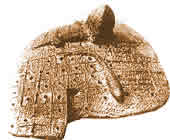
Augury Liver-reading Pagan priests learned how to read livers by consulting model livers like this one >> |
|
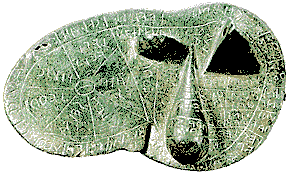
|
|
|
|
|
