|  |
||||||||||||||||||||||||||||||||
 |
|||||||||||||||||||||||||||||||||













| Facts > Pagan Ideas > Eucharist | ||||
 |
Christians share a sacred meal with their God—Pagans did it first |  |
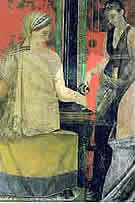
I
sit with Gods at their celestial feast." Was Christianity new? Was Christianity unique? Let's talk about the venerable Pagan sacrament of the sacred meal shared with the Gods. I guess you know about экскурсия в оружейную палату the Christian Eucharist, right?—the Lord's Supper. It commemorates the supper Jesus had with his disciples the night before the Romans nabbed Him and dragged him off, eventually to be crucified. Right? Christians still reenact that meal with Jesus, the meal with the God Jesus. You know this. Some Christians believe the meal is the body and blood of Jesus. What you maybe didn't know is that Mithras' faithful celebrated a sacred meal with their God. So did followers of Adonis, Attis, Osiris, and other Pagan Gods of the Mystery Religions. New members of the Mysteries of Isis and Osiris completed their initiation with a sacramental meal. |
||||||||

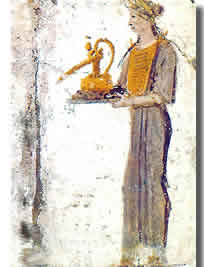

|
In everyday ancient pagan and Jewish worship living animals were sacrificed and eaten. The practice had died out, but at least theoretically people could also be sacrificed. In novels like this they often were. In our sacred bible (Genesis chapter 22) Abraham had been ready to sacrifice Isaac. The idea of human sacrifice was part of ancient culture. And so, as you see here, the logic of eating sacrificed people was also part of ancient culture.
|
...they had an improvised altar
made of mud and a coffin near it. Then two of them led up the
girl, her hands tied behind her back. I could not see who they
were, as they were in full armour, but I recognized her as Leucippe.
First they poured libations
over her head and led her round the altar while, to the accompaniment
of a flute, a priest chanted
what seemed to be an Egyptian hymn ; this at least was indicated by
the movements of his lips and the contortions of his features. Then,
at a concerted sign, all retired to some distance from the altar ; one
of the two young attendants laid her down on her back, |
| S. Gaselee, translator, Achilles
Tatius, Leucippe & Clitophon, Book 3, Ch 15. 2d century AD. Loeb
Classical Library 1917, page 165-7 Current Loeb is red; I'm not sure why. The 1917 edition is green and in Greek. 
|

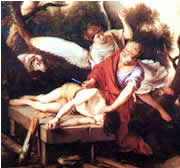 and
strapped her so by means of pegs fixed in the ground, just as the statuaries
represent Marsyas fixed to the tree ; then he took a sword and
plunging it in about the region of the heart, drew it down to the lower
part of the belly,
and
strapped her so by means of pegs fixed in the ground, just as the statuaries
represent Marsyas fixed to the tree ; then he took a sword and
plunging it in about the region of the heart, drew it down to the lower
part of the belly, Don't worry about Leucippe, by the way. Later on she rises from the dead. That also happened a lot in ancient novels. But you already knew that, right? 'Cause they told you in church. |
|
|

|
Here's how the Catholic Encyclopedia describes the Pagan Eucharists of the Mystery Religions > |
" There
was usually the meal of mystic foods— |
Christians share a sacred meal with their God—Pagans did it first |
|
The Romans' Lectisternia A lectisternia was a sacred meal in which an icon of the God was actually brought to the table with the celebrants. In Rome the whole Senate celebrated a sacred meal, with a statue of Jupiter lying on a cushion, and the two goddesses Juno and Minerva in chairs beside him. |
Yes, it does sound ridiculous.
But it wasn't to the ancients, and in fact the rite was common to many
ancient Gods. The Christian apologist Arnobius describes the process:
|
"The
lectisternium of Ceres will
be on the next Ides, for the gods
have couches; and that they may be able to lie
on softer cushions, the pillows are shaken up when they have
been pressed down."
|
| Aelius Aristides wrote about a Pagan Eucharist in which the faithful of Serapis summoned the God to a sacred meal, where they > |
" set him
at their head as guest
and diner." |
|
|
Dating
lectisternia From the start of the third century B.C. the banquet was regularly given to the three Capitoline divinities, Jupiter, Juno and Minerva on November 13th. During the Empire, the date changed to September13th. Which Gods? |
|||
|
|
|
|
 Jupiter
Christians share a sacred meal with their God—Pagans did it first |
|
The next time you're in Church
You'll know you're hearing about theology that predated Christianity by hundreds of years—in a culture where over and over people built new religions out of old parts. Wow! |
 When
they get to the part about eating a sacred meal in remembrance of the
God, remember the lectisternia of Jupiter, Juno, Minerva, Vesta,
Ceres, Diana, Venus, Mars, Mercury, Neptune, Volcanus, Apollo, Aesculapius,
Hygia, Isis, Mithras, and Jupiter Dolichenus.
When
they get to the part about eating a sacred meal in remembrance of the
God, remember the lectisternia of Jupiter, Juno, Minerva, Vesta,
Ceres, Diana, Venus, Mars, Mercury, Neptune, Volcanus, Apollo, Aesculapius,
Hygia, Isis, Mithras, and Jupiter Dolichenus.| The
Greeks' Theoxenia The Romans got the idea for their lectisternia from the theoxenia at Delphi. Ancient carvings of the ritual show a meal spread out on a banquet table, with the Gods attending. |
But
if he is one of the immortals
come down from heaven, then is this some new thing which the gods are
planning; for ever heretofore have they been wont to appear to us in
manifest form, when we sacrifice to them glorious hecatombs, and they
feast among us, sitting even where
we sit.
|
|
Christians share a sacred meal with their God—Pagans did it first |
| Eating
the Flesh of the God his followers believe >
|
"he was
intercepted and killed," and his murderers, "chopped his members
up into pieces and...devoured them." An event which his worshipers
celebrate in "recurring sacred
rites
celebrated every two years," in which, "They tear a live bull
with their teeth, representing
the cruel banquet at which the God was eaten. "
|
Christians eat a sacred meal that is the flesh of their God—but Pagans did it first |
 |
|
|||||||||||||||||||||||||||||
 Modern
Scholarship
Modern
Scholarship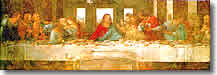 The
Lord's supper commemoratesJesus' last
meal with his disciples. The wine is
His blood. The bread is His
body. Right?
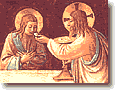
The
Lord's supper commemoratesJesus' last
meal with his disciples. The wine is
His blood. The bread is His
body. Right?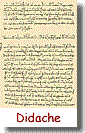 (2)
(2)

 T here
is no reason to assume that the communities
of Syria, for whom the Didache was written, followed
the same eucharistic practice and formulae that are attested in
1 Cor 11:23- 26. This is my body, this is my blood,
etc. Rather, these prayers may well belong to a direct continuation
of the fellowship meal that Jesus celebrated with his disciples
and friends. .
T here
is no reason to assume that the communities
of Syria, for whom the Didache was written, followed
the same eucharistic practice and formulae that are attested in
1 Cor 11:23- 26. This is my body, this is my blood,
etc. Rather, these prayers may well belong to a direct continuation
of the fellowship meal that Jesus celebrated with his disciples
and friends. . 
|
|
The next time you're in Church
You'll know you're celebrating an ancient Pagan ritual that predated Christianity by hundreds of years—in a culture where over and over people built new religions out of old parts. Wow! |
|
|
|