|  |
||||||||||||||||||||||||||||||||
 |
|||||||||||||||||||||||||||||||||













| Facts > Pagan Ideas > Eternal Life | ||||

 |
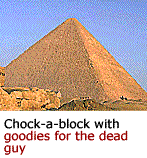
Eternal life was part of Pagan religion for thousands of years before Jesus |  |
 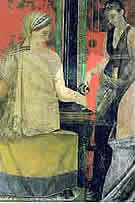
"...Our soul is
immortal, and has judges, and pays the utmost penalties whenever a man
is rid of the body."
What's more, belief in certain Gods was specifically associated with a better deal for the dead. Dionysus, for example, and Isis, and Kore. |
|
Fact is, you already know Pagans believed
in eternal life. Pagans believed in eternal life for generations before Jesus. You already know that.
And you know about the Greek tradition of putting a coin in the mouth
of the dead guy, to pay Charon to boat them across
the river Styx into Hades—where they would live forever.
Pagans believed in eternal life for generations before Jesus. You already know that. |
|
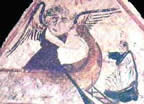
"The general heard suppose there is
a place deep under the earth called Hades" |
|
Here's how the "philosopher and satirist" Lucian described it >>
Lucian said: And most folks believe dead people end up in Pluto's Hades, where they're stuck because Pluto won't let them out—won't let them return to life on earth. |
[113] First I wish to tell you what beliefs they hold about death itself. . . . The general herd, whom philosophers call the laity. . . suppose that there is a place deep under the earth called Hades. . .The king of the [115] abyss is a brother of Zeus named Pluto . . . This Pluto, they say, has organized his state and the world below as follows. He himself has been allotted the sovereignty of the dead, whom he receives, takes in charge, and retains in close custody, permitting nobody whatsoever to go back up above, except, in all time, a very few for most important reasons. [117] Well, Pluto and Persephone, as these people
said, are the rulers and have the general over-lordship, with a great
throng of understrappers and assistants. . . |
||
|
And, says Lucian, most people believe that in Hades "good, just men who have lived virtuously" are sent off to the Elysian Fields where things are swell. |
. . . As prefects, moreover, and satraps and judges, there are two that hold court, Minos and Rhadamanthus of Crete, who are sons of Zeus. These receive the good, just men who have lived virtuously, and when many have been collected, send them off, as if to a colony, to the Elysian Fields to take part in the best life. |
||
|
But, most folks believe, bad people are punished in Hades.
|
But if they come upon any rascals,
turning them over to the Furies, they send them to the Place
of the Wicked, to be punished in proportion to their
wickedness. There-ah ! what punishment do they not undergo?
They are racked, burned, devoured by vultures, turned upon a wheel;
they roll stones uphill; and as for Tantalus, he stands on the very
brink of the lake with a parched throat, like to die, poor fellow, for
thirst! But those of the middle way
in life, and they are many, wander about in the meadow without
their bodies, in the form of shadows that vanish like
smoke in your [119] fingers. |
||
|
The next time you're in Church When they get to the part about Jesus' gift of eternal life, remember Lucian describing the beliefs of the ancients' "general herd" : Not only did your ancient Pagan-in-the-street believe in eternal life, he believed in an eternal life made up of rewards for the good and punishment for the bad. You'll know you're hearing about stuff that predated Christianity by hundreds of year. In a culture where over and over people built new religions out of old parts, by the time Jesus brought salvation, the idea of eternal life had been a part of Mediterranean religion for three thousand years Wow! |

|
 mprobabilities
of popular religion. If you read much about ancient religion you'll
come across his stuff:
mprobabilities
of popular religion. If you read much about ancient religion you'll
come across his stuff:
|
So now you know eternal life was the common belief in the pre-Christian
Mediterranean culture. Sumerian Hades—the Land of No
Return
Very cool but not perfect, because the stories can be tough to read. You can tell from looking at the tablets' cracks and chips that the stories are generally missing words, lines and whole sections (technically 'hole sections'). What's more the legends are so old the Gods are unfamiliar and the concepts are sometimes hard to figure. So be warned: even with good translations, it takes a little work to read Sumero-Assyro-Babylonian books. The payoff is you'll find some real gems. Take for example the chap named Utnapishtim, [look for the eleventh tablet of the Epic of Gilgamesh] who God told to build an ark to save mankind and the animals, on account of God was about to wipe out wicked humanity with a flood. Which He did, but the animals and Utnapishtim's people pulled through, so things turned out OK. Except for the millions of souls who drowned; but let's not count them. What do the old tablets say about life after death? Here's a smattering: |
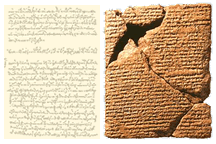 Here's a photo of a Sumerian book, cuneiformed
onto wet clay in the second millennium BC. After they wrote on the clay
the Sumerionians fired it in an oven, which made the tablet pretty durable,
if somewhat hard to fax. (This is the origin of the term, hard fax
. "Spare me your opinions, just give me the hard fax," the
king would say, and his vizier would hand over a tablet. Nowadays there
are still a few kings around, but when's the last time you saw a clay
tablet, or a vizier? Me neither.)
Here's a photo of a Sumerian book, cuneiformed
onto wet clay in the second millennium BC. After they wrote on the clay
the Sumerionians fired it in an oven, which made the tablet pretty durable,
if somewhat hard to fax. (This is the origin of the term, hard fax
. "Spare me your opinions, just give me the hard fax," the
king would say, and his vizier would hand over a tablet. Nowadays there
are still a few kings around, but when's the last time you saw a clay
tablet, or a vizier? Me neither.)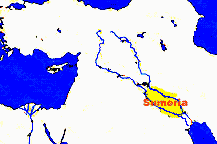 Archeologists
like to dig old tablets up—it's a learned social behavior that
earns them prestige among the archeologist societal group. (Archeologists
have no prestige outside their group.) Incredibly some people, who were
all much smarter than I am, figured out how to read these things. Right
now you can walk into pretty much any big city bookstore and walk out
with a ten-dollar paperback full of the original texts of three, four,
and five thousand (five thousand!!) year old Assyrian,
Babylonian, Sumerian books. Very
Archeologists
like to dig old tablets up—it's a learned social behavior that
earns them prestige among the archeologist societal group. (Archeologists
have no prestige outside their group.) Incredibly some people, who were
all much smarter than I am, figured out how to read these things. Right
now you can walk into pretty much any big city bookstore and walk out
with a ten-dollar paperback full of the original texts of three, four,
and five thousand (five thousand!!) year old Assyrian,
Babylonian, Sumerian books. Very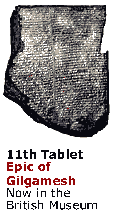 cool.
cool.
Gilgamesh's pal Enkidu went down underground into the place of the dead (translated here as Earth—the words"Hades" and "Hell" hadn't been invented yet). When Enkidu gets back Gilgamesh askers him to describe what death is like: "Tell me Earth's conditions that you found!" So he does >>
For some eternal life is pretty bleak. Gilgamesh's wife is chewed on by vermin, etc.
|
'Tell me, my friend, tell me, my friend, . . . .{gaps in the tablet} I saw him, whom you
saw at the poles [of ] |
||||||||||||||
|
For other folks eternal life is better. |
I saw him, whom you saw [die] a
sudden death: |
||||||||||||||
[Epic
of Gilgamesh, Tablet XII .iv - vi (early second millennium BC),—which
you can find in: Dalley,
Stephanie. Myths From Mesopotamia; Creation, The Flood, Gilgamesh, and
Others (1989 / 2000), pg. 123- 5]

|



|
The next time you're in Church When they get to the part about Jesus' gift of eternal life, remember the four thousand year old story of Gilgamesh's friend Enkidu describing the eternal life of dead guys in Sumero-Babylonian Underworld. You'll know you're hearing about stuff that predated Christianity by hundreds of year. In a culture where over and over people built new religions out of old parts, by the time Jesus brought salvation, the idea of eternal life had been a part of Mediterranean religion for three thousand years Wow! |
| Ishtar: "The Land of no Return" |
|
Here's the start of an early second millennium BC story called the Descent of Ishtar [a goddess] into the Nether World. >>
The point for us here is that almost five thousand years ago ancient religions had already developed the idea that dead guys ended up in a place under the earth—here they call it "the Land of no Return"—where they didn't die, but lived on forever. |
To the Land of no Return,
the realm of [Ereshkigal]
{ Goddess of the Underworld}, |
|
By the time Jesus brought salvation, the idea of eternal life had been a part of Mediterranean religions for three thousand years |
|
The next time you're in Church When they get to the part about Jesus' gift of eternal life, remember Ishtar's descent into the Underworld. You'll know you're hearing about stuff that predated Christianity by hundreds of year. In a culture where over and over people built new religions out of old parts, by the time Jesus brought salvation, the idea of eternal life had been a part of Mediterranean religion for three thousand years Wow! |
|
The rulers of Below, like those of On High, were regularly assisted in their councils and decisions by an elite corps of divinities, who were ultimately called Anunnaki. It was they, in fact, who decided (it was commonly said "to judge") the cases of each etemmu, [dead guy's soul] certainly not to grant it a more or less satisfactory infernal existence depending upon its merits, since the "merits" in question, no less than "morality" or "good conduct" on Earth, played not the slightest role in one's orientation after death, which was identical for everyone and definitively set by death itself; but in order to confirm, following the rules, the dead person's entrance into his new existence and his new residence, a bit like a clerk scrupulously maintains the register of those who are imprisoned. .... in spite of their basic conviction that death
and the afterlife were the great equalizers of human destinies, maintained
the idea that the level of existence of the efemmu was no more equal
than the destiny of the former awilu, their fate in the Beyond
depending more or less, not on their behavior, but on their conditions
of life on Earth, even if death had introduced them into a
routine of despondency and torpor. In truth, the mythology was not logical.
|

|
By the time Jesus brought salvation, the idea of eternal life had been a part of Mediterranean religions for three thousand years |
Egypt—"And he shall be in the
train of Osiris, continually and forever."
|
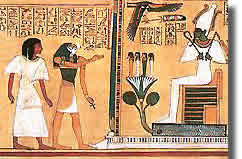

| The Book of the Dead survives, so your can read the details yourself. |
[The dead
will say:] |
|
[The first examination] |
|
|
[The second examination] |
|
|
[The third examination] |
|
|
[The fourth examination] |
|
|
This shall be said by the deceased after he has been cleaned and purified, and when he is arrayed in apparel, and is shod with white leather sandals, and his eyes have been painted with antimony, and his body has been anointed with oil, and when he offers oxen, and birds, and incense, and cakes, and beer, and garden herbs. Behold, you will draw a representation of this in color upon a new tile molded from earth upon which neither a pig nor other animals have stepped. And if you do this book on it, the deceased shall flourish, and his children shall flourish, and his name shall never fall into oblivion, and he shall be as one who fills the heart of the king and his princes. And bread, and cakes, and sweetmeats, and wine, and pieces of flesh shall be given to him upon the altar of the great god; and he shall not be turned back at any door in the Underworld, and he shall be brought in along with the kings of Upper and Lower Egypt, and he shall be in the train of Osiris, continually and forever. Effective a million times. |
|
The next time you're in Church When they get to the part about Jesus' gift of eternal life, remember the five thousand year old story of Gilgamesh's friend Enkidu describing the eternal life of dead guys in Sumero-Babylonian Underworld. You'll know you're hearing about stuff that predated Christianity by hundreds of year. In a culture where over and over people built new religions out of old parts, by the time Jesus brought salvation, the idea of eternal life had been a part of Mediterranean religion for three thousand years Wow!
|
|
Persia For the Persians, who worshiped the great Lord of the Universe, the God of Light, Ahura Mazda, the soul of the dead comes to a bride of Chinvat and was judged according to its deeds, words and thoughts in life. The good passed over the bridge safely and into paradise. The bad were dragged down to hell. Christians believe in eternal
life—but Paganism believed in it first. |
|
Mystery Religions of Greece and the Hellenized Mediterranean You've maybe noticed the Mysteries keep popping up. One of the appeals of the mysteries was the hope they gave of a better life after death. You don't have to believe me; listen to the words of the ancients
themselves
|
It was the common belief in Athens that
whoever had been taught the Mysteries would, when he died,
be deemed worthy of divine glory. Hence all were eager
for initiation. It looks as if those also who established
rites of initiation for us were no fools, but that there is a hidden
meaning in their teaching when it says that whoever arrives uninitiated
in Hades will lie in mud, but the purified and initiated
when he arrives there will dwell with gods. Quoting Socrates,
"[T]he soul of
man is immortal. At one time
it comes to an end-that which is called death-and at another is born
again, but is never finally exterminated. On these grounds a man must
live all his days as righteously as possible." And Cicero: For it appears to me that among
the many exceptional and divine things your Athens has produced and
contributed to human life, nothing is better than those mysteries. For
by means of them we have been civilized. The basis not only for living
with joy but also for dying
with a better hope. "Happy is he among men upon earth who
has seen these [Eleusinian] mysteries; but he who is uninitiate
and who has no part in them, never has like good things once he is dead,
down in the darkness and gloom." Happy is he who, having seen these [Eleusinian]
rites, goes below the hollow earth; for he knows the end of life and
he knows its god-sent beginning.
Beautiful indeed is the Mystery given us
by the blessed gods: death
is for mortals no
longer an evil, but a blessing. |

| Christians believe in eternal life—but Paganism believed in it first. |
| Greece I know you've heard the Greek myth of the dead ferried by Charon across the river Styx into Hades—the world of the dead—so I won't bore you with that. | |
| Christians believe in eternal life—but Paganism believed in it first. |
|
Orpheus/ Dionysus When Homer wrote the Iliad and Odyssey maybe around 800 BC, the archaic Greek Olympic Gods were not saviors—they didn't help people survive death, or have a better life after death. Salvation wasn't something Gods did. Orpheus changed that. In the sixth, maybe the seventh century BC he worked on the myth of the imported-to-Greece Thracian* God Dionysus, and turned it into a religion of morality and salvation. As far as we know Orpheus was the first guy in the west to do this.
How do we know about Orpheus? Well, fragments of the Orphic Gospel, called the "Orphic Hymns," are quoted by ancient writers, and Orphism lasted into late antiquity and comes up a lot in ancient texts. Anyway, by the fourth century Plato (yes, that Plato) was writing about Orpheus and his theology of salvation—and not just of eternal life, but of eternal life made better for Orphic believers. |
|
The Orphic God plates |
|
|
Jesus saves—Pagan Gods
saved first
|
|
Sabazius A fresco in Rome shows one of the God's faithful, now dead, banqueting among the immortal blessed. Jesus saves—Pagan Gods saved first |
|
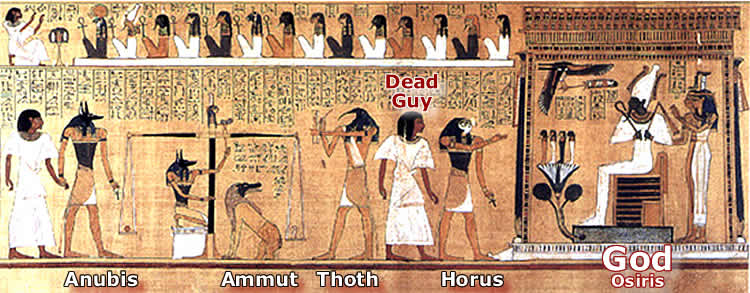
Osiris' followers found salvation in his rebirth. The exact ritual steps of the initiation into the Mysteries of Osiris, we don't know—they were kept secret on pain of death. That the initiation meant salvation could be written—and was: |
"The keys of hell and the guarantee of salvation were in the hands of the goddess, and the initiation ceremony itself a kind of voluntary death and salvation through divine grace." [Apuleius, Metamorphosis, Book 11, 21]
And, "Be of good cheer, O initiates, for the god is saved, and we shall have salvation for our woes." [Firmicus Maternus, The Error of Pagan Religions, 22.1] |
|
|
Quoting the Goddess Isis:
|
" I have come with solace and aid. Away then with tears. Cease to moan. Send sorrow fleeing. Soon through my providence shall the sun of your salvation rise." [Apuleius, Metamorphoses 11.5] |
|
Mithras Inscriptions in a Mithraeum
(temple of Mithras) in Rome read:
Enough said. |
"reborn and created for delights," and "you have saved us by the shedding of eternal blood." |
| Jesus saves—Pagan Gods saved first |
|
Cybele and Attis: The Festival of Joy—the celebration of Attis' death and rebirth. On March 22 a pine tree was brought to the sanctuary of Cybele, on it hung the effigy of Attis. The God was dead. Two days of mourning followed, but when night fell on the eve of the third day, March 25th, the worshippers turned to joy, because > |
"... suddenly a light shone in the darkness; the tomb was opened; the God had risen from the dead...[and the priest] softly whispered in their ears the glad tidings of salvation. The resurrection of the God was hailed by his disciples as a promise that they too would issue triumphant from the corruption of the grave." [for more see Frazer, Attis, chapter 1]
|
| Jesus saves—Pagan Gods saved first |
|
Eleusis An epitaph in Numidia declares faith in a immortal salvation,\\ |
"I, who always lived in a pious body, inhabit, thanks to divine law, the sweet Elysian Fields." |
|
And: |
Beautiful indeed is the Mystery given us by the blessed gods: death is for mortals no longer an evil, but a blessing. [Inscription found at Eleusis] |
|
And |
It was the common belief in Athens that whoever had been taught the Mysteries [at Eleusis] would, when he died, be deemed worthy of divine glory. Hence all were eager for initiation. [Scholiast on Aristophanes The Frogs, 158] |
|
And
|
"Happy is he among men upon earth who has seen these [Eleusinian] mysteries; but he who is uninitiate and who has no part in them, never has like good things once he is dead, down in the darkness and gloom." [Hymn to Demeter, 480-2] 0691014795 |
|
And |
It looks as if those also who established rites of initiation [into the mysteries] for us were no fools, but that there is a hidden meaning in their teaching when it says that whoever arrives uninitiated in Hades will lie in mud, but the purified and initiated when he arrives there will dwell with gods. [Plato, 'Phaedo, 69 c] |
|
Mithras Inscriptions in a Mithraeum (temple of Mithras) in Rome read: Enough said. |
"reborn and created for delights," and "you have saved us by the shedding of eternal blood." |
|
The next time you're in Church Wow! |
|
|
|